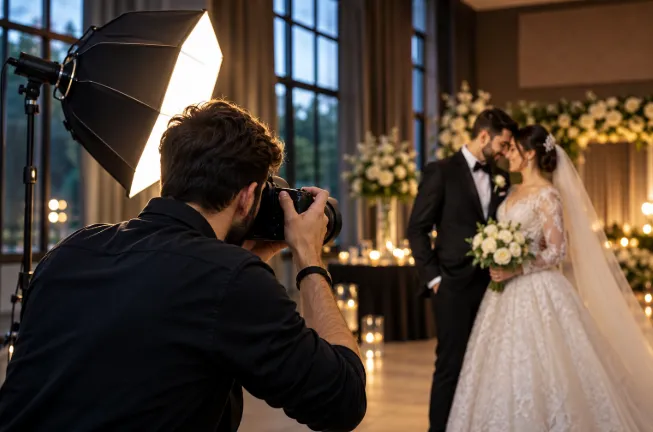
A wedding venue does not need large windows or bright natural light to produce beautiful photographs. Many couples choose historic buildings, hotel ballrooms, churches, restaurants, barns, and evening reception spaces because they offer a particular atmosphere. Unfortunately, these locations can also present lighting challenges.
Dim lighting can make it harder to capture sharp photographs, preserve natural skin tones, and show important details such as wedding dresses, flowers, table decorations, and facial expressions. Flash can help, but using it incorrectly may create harsh shadows, unwanted reflections, or photographs that lose the atmosphere of the venue.
The good news is that limited natural light does not automatically mean poor wedding photos. With an experienced photographer, thoughtful planning, and an appropriate lighting approach, you can get beautiful images even in a dark venue.
This guide explains what couples should check before booking a venue, how to discuss lighting with their photographer, and how different wedding moments can be photographed successfully in low-light conditions.
1. Check the Venue's Lighting Before the Wedding
The first step is understanding what the venue actually looks like under the lighting conditions in which your wedding will take place.
A venue may appear bright during an afternoon viewing but look completely different during an evening ceremony or reception. Large windows might provide excellent daylight, but that advantage disappears after sunset. Similarly, decorative lights may create a beautiful atmosphere without providing enough illumination for photography.
Try to visit the venue at approximately the same time your wedding events will take place.
During your visit, pay attention to:
Ceiling height: High ceilings can make it difficult for photographers to bounce flash effectively.
Wall colours: Light-coloured walls can help reflect light, while dark walls may absorb it.
Windows: Check whether natural light will reach the ceremony and portrait areas.
Existing lighting: Look at chandeliers, wall lights, spotlights, candles, and decorative fixtures.
Dark corners: Identify areas where guests may be seated or where important photographs will take place.
Lighting restrictions: Ask whether the venue allows flash, additional lighting equipment, or stands.
Do not judge the venue only by how attractive it looks. Consider whether important moments can be photographed clearly.
Ask for a Photography Walkthrough
If possible, arrange a short visit with your photographer before the wedding. They can identify suitable positions for the ceremony, family portraits, couple photographs, and reception coverage.
This visit also gives them an opportunity to understand where additional lighting may be necessary.
A photographer who has already inspected the venue can make better decisions on the wedding day instead of trying to solve every lighting problem during important moments.
2. Choose a Photographer With Low-Light Experience
When your venue has limited natural light, the photographer's experience becomes particularly important.
A photographer who mainly works outdoors in bright daylight may not have the same experience as someone who regularly photographs indoor ceremonies, evening receptions, and dark ballrooms.
Before booking, ask to see complete wedding galleries from venues with lighting conditions similar to yours.
Do not rely only on a photographer's best photographs displayed on social media. A few impressive images cannot show how consistently they handle an entire wedding.
Look for examples of:
Indoor ceremony photographs.
Couple portraits in dim rooms.
Family photographs in reception halls.
First-dance and speech photographs.
Candid photographs during evening celebrations.
Natural-looking skin tones under artificial lighting.
Pay attention to whether faces are clear, whether important details are visible, and whether the photographs still look natural.
Questions to Ask Before Hiring
Consider asking these questions during your consultation:
Have you photographed weddings in venues with very little natural light?
Can I see a complete gallery from a dark indoor wedding?
Do you use professional flash or additional lighting when necessary?
How do you photograph ceremonies where flash is not permitted?
Do you bring backup cameras, lenses, batteries, and lighting equipment?
How do you handle mixed lighting from chandeliers, LEDs, and coloured stage lights?
The photographer should be able to explain their approach in language you understand.
You do not need to choose someone simply because they own expensive equipment. Their ability to use that equipment effectively is what matters.
3. Make the Most of Available Light
Natural light is useful, but it is not the only light source that can create attractive wedding photographs.
Even a dark venue may have areas with better illumination. A window, doorway, staircase, entrance, or softly lit wall can become a suitable location for portraits.
Ask your photographer to identify these areas before the wedding.
Use Window Light When Available
If your venue has windows, schedule some portraits while daylight is still available.
Soft window light can create flattering photographs without requiring additional lighting equipment. It is particularly useful for bridal portraits, couple photographs, and getting-ready pictures.
However, avoid standing directly in front of a very bright window without discussing the exposure with your photographer. The background may become extremely bright while faces appear too dark.
A photographer can adjust the position of the couple or use additional light to balance the scene.
Use Decorative Lighting Carefully
Chandeliers, wall lights, candles, and warm decorative bulbs can contribute to the atmosphere of your photographs.
Instead of trying to make the entire venue look like daylight, a photographer can use these existing lights as part of the composition.
For example, a couple standing near a softly illuminated wall may look more natural than a couple photographed in the middle of a completely dark room with a strong flash.
Decorative lights should support the photograph rather than become so bright that they distract from the couple.
Choose a Suitable Portrait Location
If the main reception area is extremely dark, ask whether another part of the venue can be used for portraits.
A staircase, entrance hall, balcony, or quiet corner may offer better lighting and more space.
You do not need to leave the venue for every portrait. Sometimes moving a short distance can make a significant difference.
4. Understand When Flash Is Necessary
Flash is one of the most useful tools for indoor wedding photography, but it should not be used without considering the scene.
Some couples worry that flash will make their photographs look artificial. That can happen when it is used directly and too strongly. However, a skilled photographer can use flash to improve visibility while preserving the atmosphere of the venue.
Bounced Flash for Softer Lighting
When the venue has a suitable light-coloured ceiling or wall, a photographer may bounce flash off that surface.
The reflected light spreads more naturally than a direct flash pointed straight at someone's face. It can also help reduce harsh shadows.
This approach works best when the ceiling or wall is reasonably light in colour and not excessively high.
Dark wooden ceilings, black ceilings, and very tall rooms may not provide a useful surface for bouncing light.
Off-Camera Flash
For some portraits and reception photographs, photographers may position flash units away from the camera.
This gives them more control over the direction of the light. It can help separate the couple from a dark background and create more dimension in the photograph.
However, additional lighting must be positioned carefully. Equipment should not block guests, interfere with the ceremony, or create trip hazards.
When Flash Should Be Avoided
There are situations where flash may be inappropriate or prohibited.
For example:
During a religious ceremony where flash is not permitted.
During emotional moments when a sudden burst of light could be distracting.
When the venue has strict photography restrictions.
When a photographer can capture the moment effectively using available light.
Discuss these situations with your photographer and venue before the wedding.
The aim is not to use flash in every photograph. It is to use the right lighting approach for each moment.
5. Plan the Ceremony Photography in Advance
The ceremony is one of the most important parts of the wedding, and it may also be one of the most difficult moments to photograph in a dark venue.
Churches, historic buildings, and indoor ceremony spaces sometimes have limited lighting and restrictions on where photographers can stand.
Talk to your photographer about the ceremony layout before the wedding.
Consider the following:
Where will the couple stand?
Will the photographer have permission to move around?
Is flash allowed?
Will the couple stand under a spotlight or near a window?
Are there dark areas along the aisle?
Will guests or decorations block important views?
Make Sure Important Moments Are Covered
Your photographer should know which moments matter most to you.
These may include:
The bride walking down the aisle.
The groom's reaction.
The couple exchanging rings.
The first kiss.
Family reactions.
The signing of documents, if applicable.
The couple walking back down the aisle.
Good planning helps the photographer prepare for these moments rather than changing positions at the last second.
If the ceremony is particularly dark, ask whether the photographer has suitable equipment for capturing sharp images without disturbing the proceedings.
6. Schedule Couple Portraits at the Right Time
Couple portraits are often easier to manage than spontaneous moments because the photographer can choose the location, adjust the lighting, and guide the couple.
However, leaving portraits until the reception is already underway may limit your options.
If your venue has windows or outdoor areas, consider taking some portraits before sunset.
You can also arrange a short portrait session after the ceremony, when the photographer has more flexibility to position lighting.
Do Not Spend Too Long Away From Guests
It is easy to underestimate how much time wedding portraits can take.
Discuss a realistic schedule with your photographer. A short, well-planned session is often more useful than spending a long time searching for suitable locations.
Make a priority list of the photographs you want, such as:
A full-length photograph of the couple.
A close-up portrait.
A photograph showing the venue.
A natural interaction or walking photograph.
A few creative photographs using the venue's lighting.
If you feel uncomfortable posing in front of a camera, share that with your photographer. You may find these practical suggestions helpful: Wedding Photo Ideas for Couples Who Feel Awkward in Front of a Camera.
7. Get Clear Family and Group Photos
Group photographs can be challenging in dark venues because several people need to be properly illuminated at the same time.
A photograph may look acceptable when one person is standing in the light but become uneven when a large group is arranged across a wide area.
Ask your photographer to select a location with enough space and suitable lighting for family photographs.
Keep the Group Arrangements Simple
Prepare a short list of essential group combinations before the wedding.
For example:
Couple with both sets of parents.
Couple with the bride's family.
Couple with the groom's family.
Couple with siblings.
Couple with grandparents.
Couple with close friends.
This makes the session quicker and reduces the chance of missing important combinations.
Consider Guests Wearing Glasses
Flash can sometimes reflect from glasses and create bright spots over the eyes.
A photographer can reduce this problem by adjusting the lighting position, changing the angle, or making small changes to the person's position.
If someone wears glasses, they generally do not need to remove them for the photograph. The photographer should try to find an angle that preserves their normal appearance without distracting reflections.
8. Photograph the Reception Without Losing Its Atmosphere
Reception halls often have some of the most difficult lighting conditions.
There may be chandeliers, coloured stage lights, candles, LED screens, and dark seating areas all in the same room.
The challenge is capturing people clearly while preserving the atmosphere that makes the reception special.
First Dance
The first dance is an important moment, and the lighting may change throughout the song.
Ask your photographer how they plan to handle the lighting. They may use available light, carefully positioned flash, or a combination of both.
The photographs should show the couple's expressions and movement without making the background completely disappear.
Speeches and Reactions
During speeches, the person speaking may stand under a spotlight while the audience remains in darkness.
Your photographer should capture both the speaker and important reactions from guests.
A longer lens can help photograph emotional expressions without interrupting the moment.
Dancing and Candid Moments
Fast movement in low light can result in blurred photographs.
A photographer needs to balance the camera settings and lighting to capture movement while keeping the images visually appealing.
You should also discuss whether you prefer natural-looking dance-floor photographs or more dramatic images with movement and creative lighting.
Neither approach is automatically better. The important thing is choosing a style that suits your wedding.
9. Be Careful With LED Screens and Coloured Lights
Many modern reception venues use large LED screens, coloured stage lights, and decorative lighting effects.
These can look impressive in person but create difficulties in photographs.
A very bright screen behind the couple can make their faces appear too dark. Coloured lights can also create unusual skin tones, while some LED displays may produce visible bands or flickering in photographs.
Talk to your photographer about the reception setup before the event.
If possible, share photographs or videos of the venue's stage and lighting arrangement.
Your photographer may choose a different camera position, adjust exposure, or use additional light to make the couple stand out.
Do not expect every background light to appear exactly as it does to the eye. A photograph captures a particular exposure at a particular moment, and extremely bright screens may need to be balanced against the people in front of them.
10. Think About Children and Unplanned Moments
Children, guests greeting one another, emotional family reactions, and spontaneous celebrations can be some of the most meaningful wedding photographs.
These moments are difficult to plan because they happen quickly.
In dark venues, movement makes the challenge greater. A child running across the dance floor may appear blurred if the camera cannot capture the movement quickly enough.
An experienced photographer will anticipate important interactions, use suitable focusing techniques, and choose a practical position before the moment happens.
You can help by giving your photographer a list of important people and family relationships.
For example, mention if there are young children, elderly relatives, or family members whose reactions you particularly want photographed.
This helps the photographer know where to pay attention without needing to interrupt the celebration.
11. Do Not Forget the Wedding Details
Wedding photographs should tell the story of the entire day, not only show the couple and guests.
Details such as rings, flowers, invitations, table settings, cake decorations, and wedding accessories deserve attention.
These items may be placed in dim areas, so ask your photographer to photograph them somewhere with suitable lighting.
For example:
Place the rings near a window if daylight is available.
Photograph flowers against a simple background.
Move invitations away from extremely dark tables.
Use a clean, well-lit area for small accessories.
Photograph table decorations before guests arrive if possible.
This is especially helpful because reception tables can become crowded once the celebration begins.
If certain details are particularly meaningful, tell your photographer in advance rather than assuming they will notice everything.
12. Understand How Low-Light Editing Affects the Final Photos
Editing can improve low-light photographs, but it cannot completely repair every problem caused by poor exposure or missed focus.
A photographer may adjust brightness, colour balance, contrast, and noise to produce a more polished result.
However, excessive editing can make photographs look unnatural.
Noise Reduction
Low-light photographs sometimes contain visible grain or digital noise, particularly in darker areas.
Noise reduction can make the image look cleaner, but too much can remove fine details from faces, hair, clothing, and other textures.
The best result usually keeps a natural level of detail rather than making every photograph look artificially smooth.
Natural Skin Tones
Artificial lighting can make skin appear too orange, yellow, green, or blue.
A photographer should correct these colour problems while keeping skin tones realistic.
This is especially important when photographs are taken in different parts of the venue under different lighting conditions.
Preserve the Venue's Atmosphere
Not every dark photograph needs to be brightened until the room looks like daylight.
A candlelit reception should still feel warm and intimate. A dramatic dance-floor photograph can retain its atmosphere while showing the people clearly.
The goal is to improve the photograph without removing the feeling of the original moment.
13. Coordinate Photography With Videography
If you are hiring both a photographer and a videographer, discuss their lighting plans before the wedding.
Both professionals need access to important positions, and their equipment may affect each other's work.
For example, a video light positioned directly in front of the couple may change the appearance of photographs. Similarly, a photographer's flash may affect a video recording if the teams have not coordinated.
Ask both professionals to discuss:
Where they will stand during the ceremony.
How they will cover the first dance.
Whether additional lighting will be used.
How they will avoid blocking guests' views.
How they will work together during important moments.
A short conversation before the wedding can prevent unnecessary disruption.
14. Prepare a Simple Low-Light Photography Checklist
You do not need to understand professional camera settings to prepare for wedding photography.
Instead, focus on the decisions that affect your photographs and make sure your photographer understands your priorities.
Before Booking the Venue
Visit the venue at the time your wedding events will take place.
Check the ceremony and reception lighting.
Ask about flash and additional lighting restrictions.
Identify suitable locations for couple portraits.
Check whether there are bright windows or alternative portrait areas.
Before Hiring the Photographer
Request complete galleries from indoor weddings.
Ask about their experience with dark venues.
Discuss flash and available-light photography.
Confirm that they bring backup equipment.
Explain which wedding moments matter most to you.
Before the Wedding Day
Arrange a venue walkthrough if possible.
Prepare a list of essential family photographs.
Schedule couple portraits realistically.
Share details about the stage and reception lighting.
Coordinate photography and videography plans.
Confirm any restrictions with the venue.
Frequently Asked Questions
Can you take good wedding photos in a venue with no natural light?
Yes. Natural light is helpful, but it is not essential. An experienced photographer can use available venue lighting, professional flash, and additional lighting equipment to capture clear and attractive photographs.
Should wedding photographers use flash in dark venues?
Flash can be useful for portraits, group photographs, and reception coverage. However, it should be used according to the situation. During ceremonies or emotional moments, available light may be more appropriate, particularly when flash is restricted.
How can I make my wedding photos look natural in a dark hall?
Choose a photographer experienced in low-light photography. Discuss how they preserve the venue's atmosphere while keeping faces clear. A combination of available light and carefully controlled flash can often produce natural-looking results.
Should we take wedding portraits before sunset?
If your venue has windows or attractive outdoor spaces, taking some portraits before sunset can be a good idea. This gives your photographer access to natural light before the evening reception begins.
Why do people look orange or green in indoor wedding photos?
Indoor venues often combine warm bulbs, coloured LEDs, and other artificial light sources. These different light colours can affect skin tones. A photographer can manage the lighting during the shoot and correct colour balance during editing.
How can photographers avoid flash reflections in guests' glasses?
They can adjust the position and angle of the flash, change the camera position, or make small adjustments to how guests are facing the camera. Removing glasses is usually unnecessary.
Can wedding photos be fixed if the venue is too dark?
Editing can improve brightness, colour, and noise, but it cannot reliably restore details that were never captured. This is why choosing an experienced photographer and planning the lighting in advance are so important.
How much time should we allow for couple portraits?
The time depends on the number of photographs, venue layout, and lighting conditions. Discuss your priorities with the photographer and agree on a realistic schedule that does not keep you away from your guests for too long.
Final Thoughts
A wedding venue with limited natural light does not have to limit the quality of your photographs. What matters most is understanding the venue, choosing a photographer who knows how to work in difficult lighting conditions, and planning important photographs before the wedding day.
Visit the venue at the right time, discuss lighting restrictions, identify suitable portrait locations, and share your must-have photographs with your photographer.
You do not need to turn a beautiful indoor venue into a brightly lit studio. The aim is to capture the people, emotions, decorations, and atmosphere that make your wedding special.
With sensible preparation and the right photography approach, even a dimly lit ballroom, historic building, or evening reception venue can provide the setting for memorable wedding photographs.