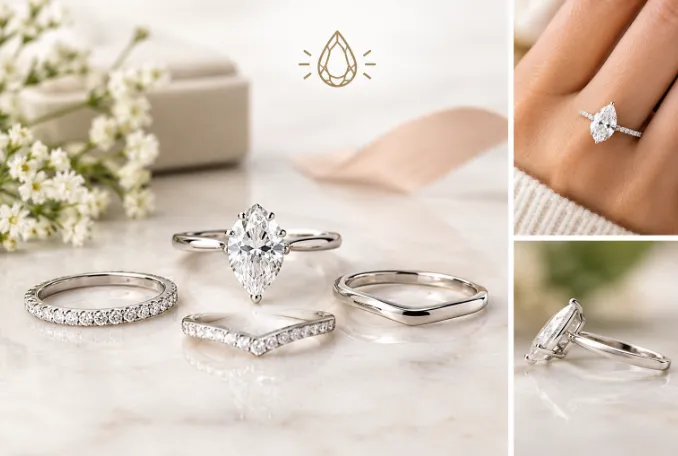
A pear-shaped diamond is one of the most flattering stones you can wear. It elongates the finger, mixes the sparkle of a round with the softness of a marquise, and looks unusual without being flashy. A low setting makes it even more practical. The stone sits close to the finger, catches less on sleeves and gloves, and feels secure during a busy day.
The trouble starts when you try to match it with a wedding band. Most advice online is written for tall, cathedral-style settings and recycles the same line: “get a curved band.” With a low-set pear, that advice is often incomplete and sometimes wrong. The real fit problems come from your stone’s orientation, the underside of your setting, and how your finger shape changes through the day.
This guide covers what other articles skip: which part of your ring actually causes clearance problems, how to test fit before you pay, which band styles suit active wearers, and how to avoid the mistakes that leave you with a band that spins, pinches, or scratches your engagement ring.
Why a Low Setting Changes the Wedding Band Rules for Pear Cuts
Before choosing a band, you need to know why a low-set pear behaves differently from other combinations. Three things matter: the stone’s orientation, the setting’s profile, and the shank’s shape.
Which End of the Pear Faces Your Wedding Band
A pear is a teardrop with one rounded end (the belly) and one pointed end (the tip). The standard way to wear it is with the tip pointing toward your fingernail. That means the rounded belly faces your hand, which is the side where your wedding band sits.
This is the detail most guides skip, and it changes the advice. The belly is the curved, wide end of the stone. A straight band lines up with a curve far more easily than it would with a sharp point. So if your pear points toward your fingertips, a plain straight band often works perfectly, especially in a low setting where the stone sits near the finger.
If you wear the pear in the unusual reverse position, tip toward the hand, the pointed end is aimed at your band and you will almost certainly need a contoured or notched design.
Where the Real Clearance Problem Hides
In a low setting, the clearance problem rarely comes from the diamond’s outline. It usually comes from three things underneath and beside it:
- The prongs near the belly. Most pear settings use two or three prongs at the rounded end. These are the parts of the ring that sit closest to the wedding band, and their height and spread decide whether a band touches them.
- The gallery rail or basket. A low setting often has a thin wire or basket under the stone. If it extends toward the band side, it can create a pinch point.
- The shank shoulders. Where the band of the engagement ring rises up to meet the head, the metal thickens. A very thin wedding band can be squeezed against that thick area.
A band that looks like it fits on a screen can still rub against a belly prong all day. That rubbing wears metal, loosens prongs over time, and leaves fine scratches on both rings.
The “Gap” Myth and What a Gap Really Means
Many shoppers believe any visible gap between their rings is a defect. In practice, a small gap is normal. It only matters when the gap is a symptom of something else:
- A gap that opens when you wear both rings on a warm day usually means the band is slightly too loose, or the rings are different widths and tilt.
- A gap at the top only (a V shape) means the engagement ring’s shoulders flare while the band is straight.
- A gap on one side only often means the pear head is slightly off-center or the stone leans.
Knowing the cause lets you pick the right fix, which might be a different band shape, a different width, or a quick adjustment by a jeweler.
Quick Guide: Which Band Style Matches Your Low-Set Pear
If you want a fast answer, use this table. Details follow in the next section.
| Your situation | Best band style |
| Pear tip toward fingernail, simple low setting | Plain straight band |
| Pear tip toward fingernail, belly prongs close to band | Slightly contoured or shadow band |
| Tip toward the hand | Notched or deep curved band |
| Halo or hidden halo low setting | Curved band with a small clearance |
| Very low, nearly flush setting | Thin straight band or open-gap band |
| You want sparkle without bulk | Pavé or shared-prong half-eternity |
| You are active and want durability | Plain polished or matte band in a hard metal |
| You want to wear it as a single piece | Soldered set or custom-fit band |
Best Wedding Band Styles for a Low-Set Pear-Shaped Ring
1. The Plain Straight Band
For most low-set pears worn tip-forward, this is the underrated winner. A plain band in a width of 1.5 to 2.5 mm sits flush against the rounded belly and lets the diamond stay the center of attention.
It works because a low setting does not tower above the finger. There is less height difference between the ring and band, so the straight line is not fighting a tall basket. It is also the most durable option, since there are no stones or intricate parts to catch.
Best for: minimalists, active wearers, and anyone whose belly prongs sit well inside the shoulder line of the ring.
Watch out for: prongs that extend beyond the shank width. Always do the paper test described later in this guide.
2. The Gently Contoured Band
A contoured band has a soft curve built into one edge. Unlike a deep chevron, the curve is subtle, which suits a low setting well because the stone does not need a lot of room.
This style solves the problem of belly prongs that stand slightly proud of the shank. The curve gives them a small pocket without creating a visible gap.
Best for: pears with a three-prong or six-prong head where the prongs sit a little wide.
Tip: ask for a “shallow contour.” Some jewelers cut a deeper curve than your ring needs, which can create an obvious gap at the top.
3. The Notched Band
A notched band has a clean cut-out designed to cradle part of the engagement ring. Many shoppers assume this is the default choice for a pear, but it is truly necessary only when the tip or a pronounced prong cluster points at the band.
A notched band can look very elegant when custom-fitted, because it appears to lock into the engagement ring. The trade-off is that it is made for one specific ring. If you ever change your engagement ring or have the head reset, a notched band may no longer fit.
Best for: tip-toward-hand wear, or low halo settings with a protruding edge.
Watch out for: weak points at the thin edges of the notch. Choose a thicker band if you work with your hands.
4. The Curved (Chevron-Style) Band
A curved band sweeps in a soft V or arc. On a pear, it echoes the teardrop outline, which many people find visually harmonious. In a low setting, a curve should be shallow, because a deep V pushes the band far from the stone and leaves unnecessary empty space.
This style suits wearers who want the two rings to look like one designed piece without paying for a fully custom band.
Best for: wearers who love the look of the bands “framing” the stone, and settings where the belly area is wider than the shank.
5. The Shadow Band
A shadow band is a plain or lightly detailed band with a slight offset or step that traces the shape of your engagement ring’s profile. It mimics the idea of a notch without cutting a hole. It is a smart option for low settings with decorative gallery details because it gives a small, even clearance.
Best for: vintage-inspired low settings, milgrain details, and rings with a delicate under-gallery.
6. The Pavé Half-Eternity Band
If your engagement ring has a pavé or hidden-halo shank, a half-eternity band with small diamonds across the top can echo the sparkle. Because your setting is low, a sparkly band does not compete as much with a towering head.
The key is choosing a band with shared prongs or a low profile, so the tiny stones do not sit above the line of your engagement ring and snag clothing.
Best for: wearers who want a “stack” look and an engagement ring that already has side stones.
Watch out for: diamond size mismatch. If your band’s melee diamonds are noticeably larger than your engagement ring’s side stones, the stack can look uneven.
7. The Full Eternity Band
A full eternity band places stones all the way around. It is beautiful, but it comes with a real caveat: it cannot be resized easily, and the underside of a full eternity can feel hard against a neighboring ring.
For a low-set pear, a full eternity works best when the stones are small and set low. If you plan to wear it every day for sports or heavy work, consider a half-eternity instead, since a full band’s underside takes constant impact.
8. The Open-Gap or Two-Part Band
This style, sometimes called a split or “cradle” band, leaves a deliberate space where your engagement ring’s head sits. It looks modern and avoids any contact with belly prongs. It is a good choice for very low or flush settings, where you want visible separation rather than a snug fit.
Best for: modern jewelry fans and anyone whose ring is a bit unusual in shape.
9. The Wide Plain Band
Most people assume a thin band is best with a pear. A band of 3 to 4 mm can look striking against a low setting because it grounds the stone visually. The caution is practical: a wide band can crowd the finger and shorten the visual length that the pear shape creates.
Best for: longer fingers and wearers who like a bold, architectural look.
Choosing the Right Metal for Your Wedding Band
Matching metals is about color and about wear. Two rings that rub together will wear each other down if one is much harder or softer.
Matching Your Engagement Ring’s Metal
The safest choice is the same metal and the same karat or purity as your engagement ring. That keeps color consistent as the rings age. White gold in particular can differ in tone between makers because of different alloys and plating, so ask for your ring’s exact specification.
If you want to mix metals, a two-tone look can work, but the more different the hardness, the more the softer one will wear where they touch.
Hardness and Wear Considerations
- Platinum: dense and durable, develops a soft patina rather than losing metal. It tends to be the premium option.
- White gold: commonly rhodium plated, which wears off and needs re-plating every year or two.
- Yellow and rose gold: warm tones that hide minor scratches well. Lower karat gold is harder but less pure.
- 14k versus 18k: 14k is more resistant to scratching, which suits daily wear and sports.
Alternative Metals and Their Limits
Titanium, tungsten and similar alternative metals are popular for men’s bands and for active wearers, but they are generally poor choices to pair with a pear engagement ring. They are much harder than gold or platinum and can scratch the softer ring in direct contact. Some, like tungsten carbide, cannot be resized and can shatter under heavy impact. If you love the look, choose a single band and avoid rings that touch directly.
Width, Thickness and Proportion: Getting the Visual Balance Right
Width Guidelines for a Low-Set Pear
As a rule of thumb, a wedding band between 1.5 mm and 2.5 mm suits most low-set pear rings. The stone is the star, and a narrower band lets the pear’s length stand out. Go wider only if your engagement ring’s shank is also wide.
A useful principle: your wedding band should not be much wider than your engagement ring’s shank where the two meet. A significant mismatch makes one ring look like it is overwhelming the other.
Thickness Matters More Than You Think
Width gets all the attention, but thickness (how deep the band sits from top to underside) affects comfort and durability. A band thinner than about 1.2 mm can bend over time, especially if you lift weights or do repeated gripping. A comfort-fit interior rounds the inside edge and makes both rings easier to slide on and off.
Finger Shape and Length
- Short or wide fingers: a slim band keeps the pear’s lengthening effect.
- Long fingers: a slightly wider band balances the stone.
- Knuckles larger than the base of the finger: choose a band that is not too snug at the base, so you can slip it over the knuckle without forcing it.
Diamond and Stone Choices for the Band
If you choose a band with stones, the details matter in a low-set stack.
Prong, Channel or Bezel-Style Settings
- Channel settings hold stones in a groove between two walls. They are smooth and snag-resistant, making them ideal for sports and daily wear.
- Shared-prong pavé gives a sparkly look with little visible metal, but the tiny prongs can catch and wear over time.
- Bezel-style accents are the most protective, with metal surrounding each stone.
Matching Quality and Color
Many people choose a band whose diamonds match the engagement ring in color. If your pear is a G or H color, an accent diamond that is noticeably warmer or whiter will stand out. Ask for a color that is within one grade of your center stone, since tiny accent diamonds are less obvious but still add up across a whole band.
Colored Gemstones for Contrast
A sapphire, emerald or ruby band can look stunning against a diamond pear, but check hardness. Sapphire is very durable, while softer stones like emerald can chip against a hard engagement ring.
Sizing and Fit: The Details Most Guides Skip
Why You Should Size Your Band Differently
Your finger swells and shrinks through the day because of temperature, salt intake, exercise and hydration. A band that fits perfectly in the morning can feel tight after a workout. Wider bands also fit snugger than narrow ones, so a 3 mm band usually needs a slightly larger size than a 2 mm one.
If your jeweler can, size the band while you are wearing the engagement ring. The two rings sit next to each other and slightly compress the finger, which changes how a band feels.
Preventing Spinning and Tilting
A low-set pear can lean toward the band if the band is too loose. Make sure your band is snug enough to stay put but not so tight that it leaves marks.
If your ring spins even when it fits, the cause is often an uneven weight distribution on the engagement ring. A small ring guard or a half-size smaller band can help.
Soldering or Connecting the Rings
Some wearers have their two rings soldered together to stop shifting. This keeps everything aligned, but it also means you cannot remove one ring without the other. It can make cleaning harder and trap dirt between the rings. If you choose it, ask the jeweler to leave a small clearance for cleaning.
Wearing Wedding Bands With a Low Setting If You Are Active
Low settings are popular with active people, and this site’s readers often fall into that group. Here is how to make your rings work with a training schedule.
Gym, Weights and Cardio
- Weightlifting: the pressure of gripping bars can bend thin bands and push a stone against a neighboring ring. Consider a silicone ring for training and keep your real rings safe.
- Running and cardio: swelling is common, so make sure your band is not too tight.
- Contact sports: remove rings completely. A low setting protects the stone from some knocks, but a pear’s pointed tip is still more vulnerable to chipping than a round stone.
Swimming, Water Sports and Sweat
Chlorine can damage some gold alloys over time and weaken prongs, and sweat can discolor lower-quality metals. Rinse your rings after swimming and remove them before long sessions in hot tubs or saltwater.
Silicone Bands as a Backup
Many athletes keep a silicone wedding band for workouts and store their real ring at home. It protects your jewelry, costs little, and is safer in the event of a snag.
Protecting the Pear’s Tip
The tip of a pear is its weakest point. A V-shaped prong or a protective bezel tip covers it. If your ring does not have one and you are active, ask a jeweler whether adding a V-prong is a good option.
Stacking Order and Wearing Options
Which Ring Goes First?
Traditionally, the wedding band goes on the finger first, nearest the heart, and the engagement ring goes on top. Many people reverse this after the ceremony, wearing the engagement ring closest to the hand so the wedding band sits farther from the stone. With a low-set pear, either order works. Try both and see which feels more comfortable.
Wearing Them on Separate Hands or Fingers
Some people choose to wear the engagement ring on one hand and the wedding band on the other, which avoids fit problems altogether. This can be a good option if your hands are very active, or if you cannot find a band that sits well.
Adding a Third Ring
If you plan to add an anniversary band later, think now about how it will stack. A straight plain band is the easiest to add to, because it creates a flat base for more rings.
How to Test Fit Before You Buy
You can avoid most mistakes with a few simple checks.
The Paper Slip Test
Slide a thin piece of paper between your rings while wearing both. If it slides through freely, there is clearance. If it catches on a prong, the band is pressing against the ring.
The Rotation Test
Rotate your rings by hand. They should move without scraping, and neither ring should leave marks on the other.
The Side Profile Check
Look at your hand from the side. Check that the band’s top edge does not rise higher than the engagement ring’s shoulders, since that can look awkward.
The Fit Wax or Try-On Method
Ask your jeweler for a wax or sample band that matches the style you plan to buy. Wear it for an hour or two, and notice any pinching or rubbing.
Take Your Ring With You
Never choose a band without your engagement ring present. Photos hide the details that matter, and a few millimeters make a big difference.
Budget: What You Can Expect to Spend
Prices vary widely by metal, width, stone count and brand, so treat these as general ranges.
- Plain gold band: often a few hundred dollars, depending on width and karat.
- Plain platinum band: typically higher than gold because of the metal.
- Pavé or half-eternity bands: cost more as the number of diamonds rises.
- Custom-fitted notched band: adds design and labor costs on top of materials.
If you are on a budget, spend your money on a well-made plain band rather than a cheap pavé one. A good plain band lasts for decades, while a low-quality diamond band can lose stones.
Off-the-Shelf or Custom: Which Is Better?
When Off-the-Shelf Works
If your ring has a simple low head and your band is a plain or lightly contoured style, a ready-made band usually works. It is faster, less expensive, and easy to replace if lost.
When Custom Is Worth the Cost
Choose custom if your ring has an unusual head, a halo, or a decorative gallery, or if your pear is worn in a nonstandard orientation. A custom band is built around your ring’s measurements, so it fits more precisely.
Matching Bands From the Original Jeweler
If your ring came from a jeweler with a matching band line, ask whether the same maker offers a coordinated option. Matching sets are designed to sit flush, but confirm the fit before purchase.
Common Mistakes to Avoid
- Buying the band before the engagement ring is finalized. Resizing or resetting the engagement ring later can change the fit.
- Following the “always curved” rule blindly. Check your orientation first.
- Ignoring the underside. Look at how the setting looks from below, not just above.
- Choosing a band that is too thin. It may bend and press against your engagement ring.
- Ignoring metal hardness. Hard metals can scratch softer ones.
- Skipping the try-on. Always test the two rings together.
- Forgetting about maintenance. Stacked rings trap dirt, so plan to clean them regularly.
Caring for Your Rings Together
Two rings worn side by side create a small crevice where soap, lotion and dirt collect. Clean them every few weeks with warm water, mild dish soap and a soft toothbrush, paying attention to the gap between them. Rinse well, dry gently, and have a jeweler check prongs once or twice a year. White gold may need re-plating, and platinum may need polishing. If you notice a loose stone or a prong that has shifted, stop wearing the ring and get it repaired.
Frequently Asked Questions
Do pear-shaped engagement rings need a curved wedding band?
Not always. If your pear points toward your fingernail, the rounded end faces the band, and a straight band often fits well. A curved or notched band is mainly needed if the tip points toward the band or the prongs sit proud of the shank.
Can I wear a straight wedding band with a low-set pear ring?
Yes, in many cases. A low setting leaves less height difference, which helps a straight band sit flush. Test the fit with the paper slip test to make sure no prongs press against the band.
Which way should the pear tip point?
The standard orientation is with the tip pointing toward your fingernail. Some people wear it the other way for style, but that usually means you need a more specialized band.
What width wedding band looks best with a pear-shaped ring?
Between 1.5 mm and 2.5 mm suits most rings, because it keeps the focus on the diamond. Wider bands can work if your engagement ring has a wide shank.
Is a low setting good for a pear-shaped diamond?
It can be, especially for active wearers, since it reduces snagging and protects the stone. Just remember the pear’s tip is still fragile, so a V-prong or similar protection is wise.
Why is there a gap between my wedding band and engagement ring?
Small gaps are normal. They become a concern if they change size during the day or show a V-shape at the top, which suggests a mismatch in shape or fit. A jeweler can often adjust it.
Should I solder my wedding band to my engagement ring?
It stops shifting and spinning, but it makes cleaning and resizing harder. Many people prefer a snug, well-fitted band that stays unsoldered.
Can a wedding band scratch my engagement ring?
Yes, especially if the metals differ in hardness or if the rings rub together. Matching metals and ensuring clearance reduces the risk.
Is a pavé wedding band a good choice for a pear ring?
It can be, particularly if your engagement ring has side stones. Choose small, low-set diamonds and check that they are protected, especially if you are active.
How much should I spend on a wedding band for a pear ring?
It depends on metal and style. A plain gold band is the most affordable, while platinum and diamond bands cost more. Put your budget toward quality construction.
What is the best wedding band for a very low or flush pear setting?
A thin plain band, a shallow contoured band, or an open-gap design usually works best. They offer clearance without drawing attention away from the stone.
Can I wear my wedding band and pear ring while working out?
Light workouts are generally fine, but remove them for weightlifting, contact sports and water activities. Silicone bands are a safe alternative.
Should I buy the wedding band at the same time as the engagement ring?
It helps. Buying both together lets the jeweler check the fit, and some retailers offer discounts on sets.
How do I know if my band is too tight?
If it leaves deep marks, causes numbness, or is hard to remove at the end of the day, it is too tight. Consider a half size larger.
Final Thoughts
The best wedding band for a pear-shaped engagement ring with a low setting is the one that sits flush with your specific ring, not the one a general rule recommends. Start by checking which way your stone points, look at where the prongs and basket sit, and test the fit with both rings on your hand. For many people, a plain straight or gently contoured band is the answer. For others, a notched or custom band is worth the extra step. Choose a metal that matches, a width that balances your stone, and a style that suits how you live, and your two rings will look like they were made for each other.