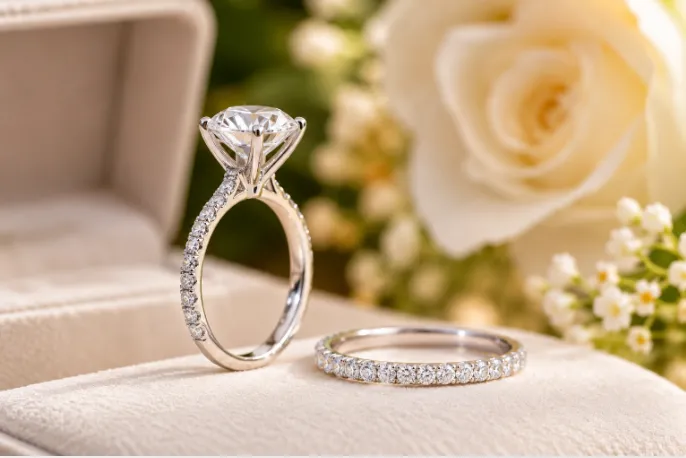
A high-setting engagement ring places its center stone noticeably above the finger. That raised profile can make the stone stand out, but it does not automatically make a wedding band easy to choose. A straight band may sit close beside the engagement ring, stop short and leave a gap, or press against part of the setting.
The fit depends on more than how high the stone sits. The basket beneath it, the gallery, the prongs, any halo or side stones, and the wedding band’s own height and thickness all affect how the rings meet. Stone shape and orientation matter too: the point of a pear or marquise, for example, may extend into the space where the band would sit.
Start by examining the engagement ring from the side, then try wedding bands with the actual ring on your hand. Ask a jeweler to check where the rings touch, whether the full stack fits comfortably, and whether a proposed shaped band will still look good on its own. A close, flush fit is one option; a small intentional gap can also look good and feel comfortable.
This guide explains how to assess the fit, compare band shapes, check sizing and costs, and decide whether a spacer, a mock-up or an adjustment to the engagement ring could help.
What a High Setting Means for Wedding Band Fit
A “high setting” describes a center stone that sits noticeably above the finger and the engagement-ring band. There is no single height that defines every high setting. Rings with similar stones can have different baskets, galleries and clearances, so height alone cannot predict whether a wedding band will fit.
Two features matter most:
- Setting height: How far the stone and setting rise above the finger.
- Clearance: The space beside the engagement ring where the wedding band would sit.
A raised stone may leave room beside the engagement-ring shank. But a wide basket or outward-facing prong can still block the wedding band. Conversely, a ring that looks low from above may have enough space beside it for a slim band.
Height and Clearance Are Different
Imagine looking at your ring from the side. The stone may sit high above your finger, while the basket underneath reaches down toward the engagement-ring band. The ring looks elevated, but the basket may leave little room for another band.
Now imagine a high solitaire with a narrow basket and prongs that stay close to the stone. The center stone is elevated, but the sides are open. A straight band might fit closely beside the engagement ring.
This is why “my ring is high” does not answer “will a straight wedding band fit?” Look at the whole setting, including the metal beneath and around the stone.
A Visible Gap Is Usually a Shape Issue
If a straight band stops before reaching the engagement-ring shank, the setting may be occupying the space the band needs. The band is not necessarily defective or the wrong size; the rings may simply have different shapes.
A small gap may be expected with a particular setting, and some people like the look. What matters is whether you find the gap attractive, whether the pair feels comfortable, and whether either ring is rubbing or pressing against the other.
Examine Your Engagement Ring From the Side
The top view shows the center stone and band design. The side view shows where the wedding band will actually fit.
Bring the engagement ring to your appointment if possible. Photos can help a jeweler understand the design, but they may not show exact dimensions or contact points. If you are shopping remotely, take clear side-view photos in good light and ask for a side profile of the wedding band against your ring.
Identify the Parts That Affect the Fit
Look at the ring’s:
- Basket or head: The metal structure holding the center stone.
- Gallery: The framework or decorative area beneath the stone.
- Gallery rail: A horizontal support that may run between the prongs.
- Prongs: The metal claws holding the stone.
- Shoulders: The parts where the engagement-ring shank rises toward the setting.
- Halo or side stones: Additional stones that may extend beyond the center setting.
A wedding band can meet any of these parts. It may fit beside the shank but hit a gallery rail, clear the basket but bump a prong, or sit under the center stone while pressing against a halo. Ask the jeweler to show you exactly where a sample band touches or stops.
Check the Band’s Actual Clearance
There is no one clearance number that guarantees a wedding band will fit every high-setting ring. The wedding band’s height and thickness matter as much as the gap beside the setting.
Ask the jeweler to compare the available space on your engagement ring with the wedding band’s actual profile. If the wedding band has raised diamonds, ask them to include the height of those settings, not just the metal band. Try the closest available sample in the width, thickness and setting style you plan to order.
This can catch a common surprise: a thin, plain band fits, but the diamond-set band you prefer does not. The two bands may share a width while having different heights, edges or settings.
Look for Outward-Extending Details
Some settings look compact from above but extend farther to the sides. A halo may project around the center stone. Side stones may have raised edges. Prongs may angle outward. Decorative gallery work may be wider than the shank.
The wedding band follows the curve of your finger; it cannot pass through a part of the engagement setting that occupies its path. Have the jeweler check the top, side and underside rather than judging the fit from the top view alone.
Use Photos as a Fitting Aid, Not a Substitute
If you are browsing online, ask for images that show the rings together from the top and side. Look for the gap, the band’s height and the areas where the rings might touch.
Use the photos to shortlist styles, then try the actual band against your engagement ring if practical. A product photo may hide a gap because of the camera angle, and a small change in the wedding band’s thickness can change the fit.
Consider Stone Shape and Orientation
The shape of the center stone can affect band fit even when the setting is high. The stone’s outline, pointed ends and orientation may create a different obstacle from a round or square center stone.
Pear and Marquise Shapes
Pear and marquise stones have a point that may extend beyond the basket. Depending on the setting, that point can sit close to the finger or project toward the wedding band. A straight band may stop short, while a V-shaped or contoured band can frame the point.
Check where the tip sits when the ring is worn normally. A band designed around the stone’s top-view outline may still collide with the setting from the side. For pear-specific options, see our guide to wedding bands for a low-setting pear-shaped engagement ring.
Oval, Emerald and Other Elongated Stones
An oval or emerald-cut stone may be set north-south, east-west or at an angle. The orientation changes the space available beside it. Side stones or a halo can extend the setting beyond the center stone’s outline.
Try bands at the actual angle you expect to wear them. If the engagement ring rotates on your finger, check whether the band still looks balanced when the center stone is slightly off-center.
Three-Stone and Cluster Settings
Three-stone and cluster rings often have a wider top profile than a solitaire. Side stones may extend toward the wedding band, or the setting may have a shape that a straight band cannot follow.
A curved, notched or open band may create room, but inspect the contact points carefully. The wedding band should not push against the side stones or their settings.
Compare Wedding Band Shapes
Once you understand where the engagement setting sits, try different band shapes. The right choice depends on the specific ring and your preferences, not just on a label such as “high-setting band.”
Straight Wedding Band
A straight band has a continuous, unshaped outline. It is often versatile because it can be worn on its own as a simple ring.
A straight band may work well when the engagement ring has a narrow basket, the setting leaves space beside the shank, and you want a band that looks complete on its own. Try the width and thickness you actually want. A slim sample may clear the setting while a thicker version hits the basket or gallery.
If a straight band leaves a gap, decide whether you like that appearance before ruling it out. A simple band with a small gap may be more comfortable and versatile than a shaped band that only looks right in one position.
Contoured or Curved Wedding Band
A contoured band has a curve designed to follow part of the engagement ring’s outline. The curve can create room around a halo, basket, side stones or another feature that blocks a straight band.
A contour may create a close, integrated look, but it can be less versatile by itself. Try it with and without the engagement ring. Check whether the curve still looks intentional alone and whether the two rings nest together without pressure.
Ask whether the band is shaped to one exact ring or is a more general curve. A close custom contour may fit beautifully in one position, but a small change in how the engagement ring sits can make the alignment look different.
Notched Wedding Band
A notched band has a small indentation where it clears part of the engagement-ring setting. It may look almost straight from above, with the notch near the center.
A notch can help when one part of the setting prevents a straight band from sitting close. It needs to be positioned and sized for your ring. If it is too shallow or narrow, the rings may press against the edges of the cutout.
Ask the jeweler to check the notch from the side and the top. Also see how the band looks and feels when worn alone.
Open or V-Shaped Wedding Band
An open band has a gap in its outline. A V-shaped band dips or points toward the setting. These designs can frame a center stone or clear a projecting tip.
Try the shape on your finger with your hand relaxed and in motion. Check whether the opening stays aligned with the stone, whether the ends feel comfortable near neighboring fingers, and whether you like the band’s appearance by itself.
Custom-Fitted Wedding Band
A custom band is designed around the shape and measurements of your engagement ring. It may be useful when standard bands do not fit as you want, or when you have a specific style in mind.
Before approving a custom design, ask to see it from the top and side. Find out whether the band must sit in one precise position, whether it can be worn alone, and whether resizing or resetting the engagement ring later could affect the fit.
For a custom design, ask whether the jeweler can make a temporary model or mock-up before producing the final band. A model can help you check the contour, gap, height and comfort on your hand. It will not show the final metal color or sparkle, but it can reveal whether the basic shape works. Confirm what the model represents and what details may differ from the finished ring.
Custom does not automatically mean better. It is most useful when it solves a specific fitting or design problem that standard options do not.
Decide Whether You Want a Flush Fit
A flush fit means the wedding band sits directly beside the engagement ring with no visible gap. Many people prefer this look, but it is not the only attractive or practical option.
Reasons to Choose a Flush Fit
A flush fit can make the rings look like a coordinated pair and create one continuous line across the finger. If this is the look you want, ask whether the rings can sit flush without pressure.
Try the actual width, thickness and setting style you plan to buy. A band should not have to press against a prong, basket or stone to eliminate a gap.
Reasons to Keep a Small Gap
A gap may be a good choice if a straight band fits comfortably but cannot reach the engagement-ring shank. It may also let you choose a band you prefer on its own rather than selecting a strongly shaped design only to close the space.
View the pair from several angles. Check whether the gap looks even when your hand is relaxed and whether the rings stay in the position you like when you move. A ring that rotates may make the space look uneven.
A gap is not automatically a defect. It is a design choice. What matters is that you like the result and the rings do not press or rub in a way that concerns you.
Avoid Forcing the Rings Together
Do not push a wedding band against the engagement ring just to make the top view look seamless. Pressure at the contact point may be uncomfortable, and repeated contact can wear the metal or affect settings over time.
If the straight band cannot sit flush, try another shape or accept a small intentional space. Ask the jeweler to evaluate the specific rings rather than relying on a general rule about flush fits.
Consider Whether the Engagement Ring Can Be Adjusted
If you strongly prefer a straight band that sits flush, ask a jeweler whether an adjustment to the engagement ring is possible. Depending on the design, a jeweler may be able to alter the setting or gallery to create more room.
This is not suitable for every ring. Changing a setting can affect the ring’s structure, the way the stone is supported, its appearance and the cost of future work. A setting that looks simple may have design or construction details that make alteration difficult. Have a qualified jeweler inspect the ring and explain the risks and likely cost before deciding.
Compare the adjustment with other options: a shaped band, a small gap or a custom-fit band. Changing a cherished engagement ring solely to accommodate one wedding band may not be worthwhile if a comfortable band option already exists.
Choose the Right Width, Thickness and Profile
The wedding band’s proportions affect both appearance and fit. Width describes how much of the finger the band covers from above. Thickness describes its depth from the finger-facing surface to the outer surface. Profile describes the shape of its cross-section, such as flat, rounded or domed.
Compare the Full Stack on Your Finger
A band that looks delicate alone can seem quite different beside an engagement ring. Try a few widths and view the full stack from above and from the side.
Ask yourself:
- Does the band balance the engagement-ring shank?
- Does the center setting still stand out the way you want?
- Does the combined width crowd nearby fingers?
- Does the stack feel snug at the base of your finger?
- Does the band make the setting look more balanced or more top-heavy?
There is no required width ratio. A narrow band beside a substantial engagement ring can look intentionally delicate; a wider one can make the stack feel bolder. Use your own hand and comfort as the guide.
Check Thickness, Not Just Width
Two bands with the same width can have different depths and settings. A thick band or raised stones may hit the basket even if a slim sample fits.
Ask the jeweler to compare the wedding band’s full profile with the available space beside your engagement ring. If you like a diamond-set band, test a sample with a similar setting height. Do not assume a plain sample will predict how a pavé or prong-set band will fit.
Size the Rings as a Stack
Try both rings together when checking fit. The full stack covers more of your finger than either ring alone and may feel tighter. A wide engagement ring paired with a wide wedding band can need a different size assessment than a narrow pair.
Finger size can vary through the day and with temperature. A jeweler can help assess a comfortable fit, but do not make a decision based on one quick try-on if your hands are unusually hot or cold. The rings should feel secure without pinching, and you should be able to remove them without pain.
If you expect to wear the wedding band alone sometimes, check that it also fits comfortably on its own. The engagement ring and wedding band may not behave identically when separated.
Coordinate Metal, Finish and Detail
Your wedding band does not have to match the engagement ring exactly. Matching colors and finishes can make the pair feel coordinated; contrast can make each ring stand out.
Match Metal for a Unified Look
Choosing the same metal color is a simple way to create a cohesive pair. Ask the jeweler what metals and alloys the rings contain and whether a finish requires periodic care.
Two rings that look similar in a display case may look different in daylight or after one ring is polished. Try them together in more than one lighting condition if possible.
Mix Metals With Intention
Mixed metals can look personal and distinctive. A different color for the wedding band can separate it visually from the engagement ring. Try the combination on your hand rather than judging it from a sample ring.
The metals may also differ in hardness and wear characteristics. The Gemological Institute of America notes that stacked rings made from metals with different hardness can wear at different rates, and recommends discussing care with a qualified jeweler. GIA’s ring-stacking guide discusses using a buffer ring in some mixed-metal stacks. Whether a spacer helps your pair depends on the specific metals, fit and contact points, so treat it as an option to ask about—not a universal fix.
Balance Sparkle, Texture and Pattern
A plain band can give a detailed engagement ring visual breathing room. A diamond-set, engraved or textured band adds another layer of detail.
Look closely at where the rings meet. Raised stones, prongs and textured edges can contact the engagement-ring setting. Ask the jeweler to inspect that contact, especially if you want the bands to sit closely together.
A subtle detail can add interest without competing with the center stone. Consider a polished finish, matte surface, milgrain edging or fine pattern. Try the band with the engagement ring and alone.
Consider Eternity Bands and Resizing
An eternity band has stones set around all or most of the ring. It can add continuous sparkle, but consider its fit and future resizing before you choose it as a wedding band.
The stones and settings can make resizing more difficult than resizing a plain band. The exact options depend on the ring’s construction, how far the stones extend and the amount of size change needed. Ask the jeweler what can be done if the fit changes later.
Also check how the stones sit next to the engagement ring. Raised settings may touch the basket or prongs, and the band may rotate so a different section contacts the engagement ring. Try it in motion and ask the jeweler to inspect the contact points. If you want the look of an eternity band with easier adjustment options, compare designs with stones only across the top portion of the band.
Consider Spacers Carefully
A spacer is a thin ring worn between two rings to create separation or reduce direct contact. A spacer may help in some pairings, but it is not a universal solution.
It adds another ring to the stack, which can make the finger feel tighter or the overall look bulkier. It may also shift position or fail to prevent contact at the specific point causing concern. Whether it helps depends on the rings’ shapes, materials and fit.
Ask the jeweler to show you the spacer between your actual rings and check the full stack on your hand. Confirm whether it solves a specific contact issue and whether it remains comfortable when you move. If the rings still collide or the stack feels cramped, a different wedding-band shape may be a better answer.
Think About Wear, Movement and Maintenance
A wedding band is for everyday wear, so it should feel comfortable beyond the jewelry-store mirror. A high setting can catch on fabric or bump against objects, and adding a second ring may change how the stack behaves.
Test the Pair in Motion
Wear both rings and try ordinary movements:
- Make a gentle fist.
- Bend your finger.
- Hold a phone or mug.
- Turn your hand palm-up and palm-down.
- Let your hand hang naturally.
- Notice whether either ring shifts, overlaps or rotates.
- Check whether the rings crowd neighboring fingers.
This can reveal a pressure point or a band that will not stay where you want it. If something feels uncomfortable during a fitting, ask to try another profile before ordering.
Consider Gloves and Clothing
If you regularly wear gloves, try putting them on and taking them off while wearing the rings. A raised setting can catch on some fabrics. The wedding band may also change how the engagement ring slides past a glove.
Think about other routines, such as putting on sweaters, washing your hands or carrying bags. You do not need to predict every snag, but it helps to know whether the ring’s height and shape suit your daily life.
Ask Where the Rings May Rub
Rings may touch at the shanks, settings or edges. Ask the jeweler to point out these contact areas and explain whether the two rings are likely to rub during normal movement.
Pay particular attention if one band has raised stones or is made from a different metal. A wedding band should not be used to push, stabilize or protect a loose engagement-ring setting. If you notice movement, snagging or a change in how the rings sit, have the engagement ring checked on its own.
Plan for Periodic Inspection
If you wear the rings together every day, include the pairing in your regular jewelry checks. Ask a jeweler to look for signs of rubbing, loose stones or worn areas when you bring the rings in for cleaning or inspection.
Inspecting the rings does not require you to worry over every small mark. It gives you a chance to catch a fit or setting issue before it becomes a larger repair.
Understand Cost and Future Changes
Band shape and setting affect more than appearance. They can change the price, how easily the ring can be resized, and whether it will still fit if the engagement ring changes later.
What Can Affect the Price
A plain straight band is often simpler to make than a custom-contoured band, but prices vary by metal, width, weight, finish and retailer. Diamond-set bands add the cost of stones and setting work. A custom band can involve design time, modeling and additional fitting. A spacer adds another ring to the purchase.
When comparing prices, compare like with like. Ask for the metal, width, thickness, stone details and whether the quote includes customization or later adjustments. The average cost of a wedding ring guide can help with broader budgeting, but your exact design and market determine the quote.
Ask About Resizing Before You Buy
Some bands are easier to resize than others. A plain band may be simpler to adjust than a ring with stones around much of its circumference. An eternity band or deeply contoured band may be more complicated to alter because changing its size can affect how it sits or how its stones align.
Ask the jeweler what resizing would involve for the exact design. If your size changes later, would the band need to be reshaped, remade or adjusted in another way? Is resizing included in the purchase price? Get the practical answer before ordering, especially for a custom or all-around diamond design.
Consider Future Changes to the Engagement Ring
You may eventually resize, repair or reset your engagement ring. A custom band shaped to fit one precise setting may no longer align if that setting changes.
This does not mean you should avoid a custom band. It means you should understand the tradeoff. If you expect to keep the engagement ring’s setting for the long term, an exact contour may suit you. If you want more flexibility, a straight or gently curved band may be easier to pair with future changes.
Ask a Jeweler These Questions Before Ordering
Bring the engagement ring and, if possible, try a wedding band in the width and thickness you are considering. A useful appointment should answer how the pair fits, where it touches, and what may change if either ring is resized.
Questions About Fit
- Can this straight band sit close to the engagement ring without hitting the setting?
- Where exactly will the rings touch?
- Does the wedding band’s height and thickness clear the basket and gallery?
- If there will be a gap, how does it look from the side and top?
- Would a curved or notched band sit more comfortably?
- Does the band need to stay in one exact position?
- Can I try it in the width and profile I plan to order?
- Does the full stack still feel comfortable when I bend my finger?
- Would a spacer reduce contact, or would it make the stack too tight?
Questions About Construction and Future Changes
- Could the rings rub against each other during normal wear?
- Could the wedding band’s stones or edges contact the engagement-ring setting?
- Could the engagement-ring setting be adjusted to create more room? What would that change?
- What would resizing this band involve?
- If I resize or reset the engagement ring, could the wedding band stop fitting?
- What areas should I ask you to inspect during future maintenance?
- If the wedding band is custom-made, can I approve a model or mock-up first?
- Is the quoted price for the final dimensions and materials I tried?
Take notes on the band’s width, thickness, metal, shape and price. That makes it easier to compare options accurately.
Common Mistakes to Avoid
Assuming a High Stone Guarantees a Flush Fit
The center stone may sit high while the basket, gallery rail or prongs still occupy the wedding band’s path. Examine the complete side profile.
Buying From a Top-Down Photo Alone
A top view may hide the gap or the point where the band hits the setting. Ask for a side view and try the actual rings together if possible.
Choosing a Curved Band Without Trying It Alone
A contour may look perfect beside the engagement ring but feel unusual by itself. If you expect to wear the wedding band alone, test that before ordering.
Prioritizing a Seamless Look Over Comfort
A flush fit is a preference, not a requirement. If the rings press against each other, feel tight or shift awkwardly, try another profile or accept a small gap.
Forgetting the Band’s Thickness
Two bands of the same width can have different depths and settings. A thick band or raised stones may hit the basket even if a slim sample fits.
Ignoring the Shape and Orientation of the Stone
A pear or marquise point, an east-west setting, or wide side stones can change the fit. Check the actual orientation and setting rather than choosing a band based only on the stone’s name.
Choosing an Eternity Band Without Asking About Resizing
A band with stones around all or most of its circumference may be difficult to resize. Ask what options would be available if the fit changes.
Treating a Spacer as an Automatic Fix
A spacer may add bulk without solving the contact point. Try it with the actual rings and ask the jeweler what problem it addresses.
Changing the Engagement Ring Without Comparing Alternatives
An adjustment may create room for a straight band, but it can affect the setting, appearance, cost and stone security. Compare it with a shaped band or intentional gap before deciding.
Ignoring Future Resizing or Repairs
A custom band may stop aligning if the engagement ring’s size or setting changes. Ask how likely that is for your design and what alterations would involve.
Assuming Both Rings Need to Look Identical
The metals, finishes and styles can differ. Choose a pairing you enjoy and have the jeweler check how the materials and settings will wear together.
A Step-by-Step Fitting Process
Use this sequence to compare options without trying every style at once.
- Bring the engagement ring. The actual setting reveals more than a description or photo.
- Inspect it from the side. Identify the basket, gallery, prongs and any feature that could block a band.
- Try a straight band. Start with a simple shape, then compare widths and thicknesses.
- Check real clearance. Have the jeweler compare the available space with the wedding band’s full profile.
- Try shaped options. Compare curved, notched, open or custom-fit styles if the straight band does not work as you want.
- Check the contact points. See whether the bands touch the shank, basket, prongs or stones.
- Move your hand. Test comfort, shifting, rotation and snagging.
- Check the full stack’s size. Make sure both rings together feel comfortable, not pinched.
- Try the wedding band alone. Confirm you like its shape without the engagement ring.
- Compare in natural light. Look at metal color, finish and proportions outside display lighting if possible.
- Ask about care, cost and resizing. Understand what the design means for future maintenance and changes.
- For custom work, review a mock-up. Check the shape and comfort before the final band is made.
- Record the details. Note dimensions, materials, shape and price before comparing another option.
Frequently Asked Questions
Can I Wear a Straight Wedding Band With a High-Setting Engagement Ring?
Often, yes. A high-set solitaire may leave enough space for a straight band, but the basket, gallery, prongs and band thickness determine the actual fit. Try the band against your engagement ring and inspect it from the side.
Will a High-Setting Engagement Ring Always Sit Flush With a Wedding Band?
No. A raised center stone does not guarantee that a band can sit directly beside the engagement ring. The basket or prongs may block its path. A shaped band or a small gap may work better.
Is a Gap Between an Engagement Ring and Wedding Band Bad?
Not necessarily. A gap can be a deliberate design choice and may be more comfortable than forcing the rings together. Decide whether you like its appearance, and ask a jeweler to check that the rings are not pressing or rubbing in a way that concerns you.
Is a Curved Wedding Band Comfortable to Wear Alone?
It can be, but the curve may look more noticeable without the engagement ring. Try it both ways. If you plan to wear the wedding band alone often, choose a shape you enjoy on its own.
Can a Wedding Band Touch the Engagement Ring’s Prongs?
The rings may sit close, but persistent pressure or rubbing at the prongs is worth checking with a jeweler. Ask them to inspect the pair in person and explain where contact occurs.
What If My Engagement Ring Has a Halo?
A halo may extend beyond the engagement-ring shank and block a straight band. Try a slim straight band first, then compare a curved, notched or custom option if needed. Check that the wedding band does not press against the halo’s stones or setting.
Does Stone Shape Affect Which Wedding Band Fits?
Yes. A pear or marquise point, a wide halo, side stones or an east-west setting can change where a wedding band can sit. Check the actual shape and orientation of the setting, not only the height of the center stone.
Should My Wedding Band Match My Engagement Ring’s Metal?
That is a style choice. Matching metals can make the pair look coordinated, while mixed metals create contrast. Try the combination in person and ask about the specific materials and how the rings may wear together.
Can I Order a Wedding Band Before My Engagement Ring Is Finished?
You can explore styles, but the finished engagement ring gives the most accurate fit check. Small differences in its basket, prongs or band can change the clearance. If you need to order early, ask the jeweler to confirm the fit against the final ring design.
Do I Need a Custom Wedding Band for a High Setting?
Not always. A straight band may fit a high-set solitaire. Consider a custom design if standard bands do not fit as you want or if you need a specific shape to clear the setting. Try existing styles first so you know what problem a custom band needs to solve.
Should I Size My Rings Separately or as a Stack?
Try both rings together when assessing comfort. The full stack covers more of your finger and can feel tighter than either ring alone. Ask the jeweler to assess the pair, and also check that each ring feels comfortable when worn separately if you expect to wear them that way.
Should the Wedding Band Go Above or Below the Engagement Ring?
There is no single order that suits everyone. Many people wear the wedding band closer to the hand, but you can choose the order that feels comfortable and looks right to you. Try both arrangements if the rings’ shapes allow it.
Will a Spacer Fix a Gap Between My Rings?
Sometimes, but not always. A spacer may separate surfaces that rub, but it can add bulk or make the stack feel tight. Have a jeweler try it with your actual rings and explain what contact it is meant to prevent.
Can a Jeweler Change My Engagement Ring So a Straight Band Fits?
Possibly. A jeweler can assess whether the setting or gallery can be changed, but alterations may affect the ring’s structure, appearance, stone security and cost. Compare that option with a shaped band or a small gap before deciding.
Is an Eternity Wedding Band Difficult to Resize?
It can be. Stones set around all or most of the band may limit resizing options. The difficulty depends on the design and the amount of size change needed, so ask the jeweler before purchasing.
Should I Solder My Engagement Ring and Wedding Band Together?
Soldering joins the rings so they move as one pair. It also affects how you wear, resize and service them. Ask a jeweler about the practical effects for your specific rings before deciding.
Choose a Wedding Band That Works With Your Ring
The right wedding band depends on the setting’s shape and clearance, the band’s proportions, the center stone’s outline, and how the pair feels on your hand. A straight band may fit comfortably. A curved or notched band may bring the rings closer. A spacer or an adjustment to the engagement ring may help in some cases, but each has tradeoffs. A small visible gap may simply be the look you prefer.
Bring the engagement ring to a fitting, look at the pair from the side, and test it while moving your hand. Ask the jeweler to compare the actual dimensions, identify contact points, and explain what resizing or future changes could mean. For custom work, review a mock-up before approving the finished band. Then choose for comfort and appearance—not because you think a wedding set has to follow one fixed rule.