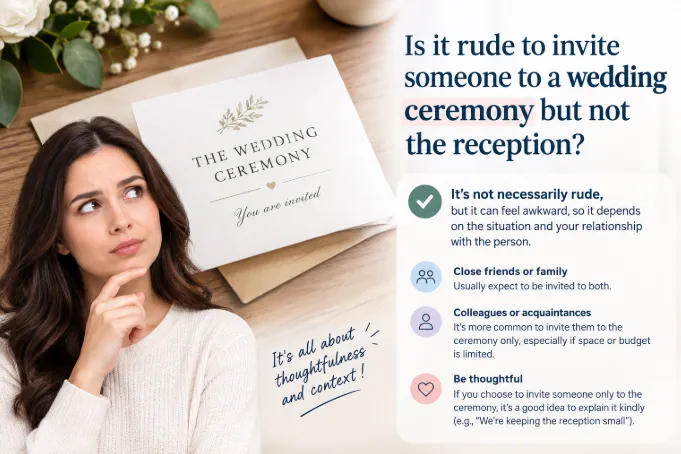
You are staring at a guest list that will not fit the venue, the budget, or both. Cutting people entirely feels harsh. Inviting them to the ceremony alone feels like a fair compromise, but you worry it will read as a snub.
The worry is reasonable, and the answer is reassuring. A ceremony-only invitation is a long-standing, widely accepted way to include more people than a reception can hold. It becomes rude only when it is handled carelessly: vague wording, uneven lines, a dead gap between events, or a guest left standing on the curb while everyone else walks in to dinner.
This guide goes further than the usual advice to send a separate card. You will find a four-part test for your own guest list, wording you can copy, a timing chart for the gap between events, day-of logistics most couples forget, and scripts for the uncomfortable conversations.
The Short Answer: Is It Rude?
No. A ceremony and a reception are two events with two very different price tags. Adding a guest to the ceremony costs one chair. Adding a guest to the reception costs a plated meal, a drink allowance, a seat at a table and a slice of the service staff's time. Hosts are entitled to draw a line between the two.
What decides whether the invitation is polite is not the split itself but how it is carried out. Run your plan through this four-part test:
- Clarity. The guest knows exactly which events they are invited to before they spend any money or time.
- Consistency. Everyone in the same category gets the same invitation. No unexplained exceptions.
- Couples stay together. Spouses, fiancés and long-term partners are invited to the same events.
- No strings. The guest is not pressured for a gift, treated as an audience, or left without a graceful exit.
Pass all four and the invitation is courteous. Fail one and you will probably hear about it, even if nobody says it to your face.
Why a Ceremony-Only Invitation Can Hurt
Understanding the emotional mechanics is the fastest way to prevent hurt feelings.
It can read as a ranking
A full invitation says, "You are among the people we most wanted here." A partial one can sound like, "You made the second list." Every guest list has tiers, so the goal is not to hide them but to make the logic visible and fair. "All colleagues at the ceremony" is a policy. "Some colleagues at both, some at one" is a ranking.
The two events mean different things to different people
For many families the ceremony carries the emotional weight and the reception carries the social weight. A grandmother may treasure the vows and dread a loud dinner. A college friend may care little about the service and a great deal about the dancing. Before you split anyone, ask which half that person would actually choose.
The guest pays the costs of a short event
A ceremony-only guest still dresses up, finds parking, arranges childcare or takes time off work. For a twenty-minute service, that effort can feel lopsided unless the host makes the invitation feel genuinely wanted.
The "curb moment" is what people really mean by rude
Picture the scene: the ceremony ends, the wedding party heads to the venue next door, and a handful of guests stand on the pavement wondering whether they should follow. That single moment is behind most of the complaints about this practice, and it is entirely preventable with a little planning, which the timing section below covers.
When a Ceremony-Only Invitation Is Perfectly Acceptable
Your venue or budget imposes a hard limit
If the reception hall holds 80 and you have 140 people who matter, splitting the list is a practical, honest solution. Guests generally prefer partial inclusion to none, and most ceremony spaces flex more easily than dining rooms.
The ceremony is a community event
In many faith traditions and tight-knit communities, the ceremony is open to extended family, neighbors and congregation members, while the meal is for a smaller circle. Guests who grew up in these settings expect the arrangement and rarely read it as exclusion.
The guest would genuinely prefer the shorter version
Older relatives who tire easily, colleagues who avoid late nights and friends with young children often welcome a ceremony-only invitation. If you are unsure, ask privately: "We can't host everyone at the reception, but we'd love you at the ceremony. Would that work for you?"
Someone else is hosting the reception
When parents or a relative host the reception, they often have a list of their own. Ceremony invitations are a common way for couples to honor those relationships without breaking the reception cap.
You are being honest about a real constraint
Guests respond well to a short, truthful reason. A budget or capacity limit lands far better than silence or a vague excuse.
When It Crosses the Line into Rude
The guest is left to guess
If someone will naturally expect dinner and you let them assume it, you have set them up for an uncomfortable moment. Be explicit about what the invitation covers.
A couple is split
Inviting one half of a couple to the reception and the other to the ceremony only is among the clearest etiquette breaches. Married, engaged and long-term partners are invited as a unit, to the same events.
Rules shift inside the same role
If every bridesmaid may bring a guest to the reception and one is told hers is ceremony-only, expect lasting resentment. Apply any rule to everyone in the same role.
A gift is implied
An invitation is a gesture of welcome, not a transaction. Do not include registry details with ceremony-only invitations, and never hint that a present is expected.
The schedule leaves guests stranded
A noon ceremony and a seven o'clock reception leave ceremony-only guests with nothing to do and no clear sign of whether they may linger. If your timeline has a long gap, those guests deserve a plan.
The invitation is used to fill seats
Inviting people to make the room look full, while showing no interest in them beyond that, is something guests can sense. Include people because you want them there.
Who Gets a Ceremony-Only Invitation (and Who Never Should)
There is no universal rule, but the strongest guest lists define the ceremony-only group by a category, never by a mood. Pick a category and apply it to everyone in it.
Groups that commonly work well
- Extended family: second cousins, great-aunts and uncles, and relatives you see once a decade.
- Colleagues: many coworkers would rather attend a short service than give up an entire evening.
- Parents' friends and neighbors: people who care about the milestone but do not expect a seat at the table.
- Old friends you have drifted from: someone you want to acknowledge but who would know almost nobody at a dinner.
Groups to avoid putting on the ceremony-only list
Your siblings, your wedding party, your closest friends and anyone who travels a long distance should almost always receive a full invitation. These are the guests most likely to feel the sting permanently, and the ones you are most likely to see again at every future family event.
A quick sorting question
For each name, ask: "If this person learned that someone of equal closeness was invited to everything, would I be comfortable explaining the difference?" If the answer is no, move them up or move the comparison person down.
How to Word a Ceremony-Only Invitation
Precise wording prevents most problems. The goal is to be unmistakable without sounding cold.
Use a separate ceremony card
The cleanest method is two invitation suites: a full-day suite and a ceremony suite. The ceremony version lists only the ceremony details and says nothing about the reception. Guests receive exactly what applies to them, and no one has to read between the lines.
Sample wording you can adapt
- "Together with their families, Maya and Daniel request the pleasure of your company at their wedding ceremony. Saturday, the fourteenth of June, at four o'clock. St. Anne's Church."
- "We would be honored to have you with us as we exchange vows. Ceremony at three o'clock in the garden."
- "Our celebration afterward will be small, but we would love you to witness our ceremony. Please join us at two o'clock on the courthouse steps."
Add one handwritten line
A personal note changes how the whole invitation feels. Something like, "We wish we could host everyone at dinner, but we wanted you there for the moment that matters most," tells the guest they were chosen on purpose.
What to leave off the card
Omit the reception address, meal choices and registry link. Removing these details removes ambiguity and prevents anyone from turning up at the wrong event.
Check your wedding website and digital invitations
A public website that lists the full schedule shows ceremony-only guests exactly what they were not invited to. Use a password-protected page or separate guest groups so each invitee sees only their own events, and preview the site from a ceremony-only guest's point of view before sending.
Mind the social media trail
Couples sometimes forget that engagement posts, shared photo albums and group chats can reveal the reception to people who are not attending. Agree with your wedding party in advance about what gets posted and when.
The Gap Between the Ceremony and the Reception
This is the detail most couples overlook, and it is where good intentions most often go wrong. The longer the gap, the more deliberately you need to plan for guests who will not be staying.
| Gap length | What ceremony-only guests face | Best fix |
|---|---|---|
| Under 1 hour | A natural goodbye as the party moves on | A short send-off and a clear thank-you |
| 1 to 2 hours | Some idle time, uncertainty about leaving | Light refreshments after the ceremony |
| 3 hours or more | Nothing to do, awkward exit | Shorten the gap, or hold a brief gathering with cake and a toast |
Give guests a clear ending
A petal toss, bubble send-off or group photo gives ceremony-only guests something to take part in and signals when the moment is over. Without it, people drift, unsure whether leaving is polite.
Offer something small afterward
Coffee, lemonade and cake outside the ceremony space cost far less than a meal and turn a potentially awkward exit into a warm one. Even one drink and a toast shows hospitality.
Tell people what to expect
A line such as "Light refreshments will follow the ceremony" removes guesswork. Guests are far more relaxed when they know how the afternoon will unfold.
Assign a host for the exit
Ask a friend or relative to thank ceremony-only guests, guide them toward refreshments and say goodbye. This spares the couple from managing a delicate moment on their wedding day.
Think about guests who traveled
If any ceremony-only guests came from out of town, suggest a nearby restaurant or arrange a table at a casual place. A small gesture like this tells them you thought about their whole day.
Day-of Logistics Most Couples Forget
These details rarely appear in etiquette articles, yet they shape how ceremony-only guests feel more than any wording does.
Seating
Do not seat ceremony-only guests in the back rows by default. A mixed arrangement signals that every guest is part of the moment, and it avoids a visible divide between guests who will stay and guests who will leave.
Timing the meal around the ceremony
A mid-afternoon ceremony leaves guests hungry, and ceremony-only guests will not be fed afterward. Where possible, schedule the ceremony after a typical mealtime, or provide a snack.
Receiving lines and photos
If you hold a receiving line, include everyone. If a group photo is planned, invite ceremony-only guests to join it so they leave with a memory, not a feeling of being left out.
Parking and transport
Ceremony-only guests who park at a venue they will not enter again may face a long walk or a ticket. Mention parking and any shuttle details on the card.
Dress code
Be clear about attire. Guests who dress formally for a ceremony and then watch the reception attendees in the same outfits may feel more conspicuous than guests who know what to wear.
Gifts and Ceremony-Only Guests
Do ceremony-only guests owe a gift?
Generally no. A guest who attends only the ceremony has not received the meal or the full hospitality of the day, so the traditional expectation of a gift is much lighter. Many will still bring a card or a modest present, but nobody should expect one.
What hosts should do
Leave gift and registry information off ceremony-only invitations. If a guest brings a present anyway, accept it warmly and send a thank-you note, exactly as you would for any other gift.
What guests can do
A heartfelt card is entirely sufficient. If you want to give something, choose an amount that feels comfortable. You do not need to match what a reception guest might spend.
Cultural and Religious Traditions Around Split Invitations
The assumption that everyone at a ceremony attends the reception is far from universal.
Large ceremonies and small receptions
In many communities the ceremony is a public occasion and the reception is for immediate family and close friends. Attending the ceremony alone is a different role, not a lesser one.
Open religious services
Some congregations welcome members to the wedding service without any individual invitation. The reception is then a separate, private event, and guests understand the distinction.
Multi-day celebrations
Where weddings span several events, each event may have its own guest list. Being invited to one does not imply an invitation to the others.
Explaining across backgrounds
If your guests come from different traditions, a short explanation avoids confusion: "Our reception is for family only, but we would love you at the ceremony." One sentence prevents many misunderstandings.
Scripts for Awkward Conversations
Even a flawless plan can meet a disappointed guest. Having calm, honest wording ready makes the conversation easier for both of you.
"Why wasn't I invited to the reception?"
Keep it short and true: "We had a strict limit on the reception and had to make some hard choices. We really wanted you at the ceremony." Do not over-explain or compare them to other guests.
"It feels like you ranked us."
Acknowledge the feeling without changing the decision: "I understand it can feel that way, and I'm sorry it does. It came down to space and budget, not how much you matter to us."
"Can I bring a plus-one to the reception?"
A warm, firm answer works best: "We wish we could, but our numbers are fixed and we can't add anyone." Avoid one-off exceptions unless you can offer them to everyone in the same situation.
A ceremony-only guest turns up at the reception
Stay calm. If there is room and it is easy to accommodate them, a gracious exception avoids a scene. If not, ask a trusted friend to redirect them privately rather than confronting them in public.
A relative pushes you to add someone
Hold the line kindly: "We appreciate you thinking of them, but we've settled on our list." You do not owe a further justification, especially if the person raising it is not paying.
If You Are the Guest Invited Only to the Ceremony
Should you be offended?
Probably not. In most cases the couple made hard decisions about money and space, not about how much they value you. Being invited to witness the vows is a real compliment.
Should you attend?
If the ceremony matters to you and the logistics are reasonable, attending is a generous gesture. If travel, time or cost is a serious burden, declining politely and sending good wishes is entirely acceptable.
How to decline gracefully
A short note works well: "Thank you so much for the invitation. I'm delighted for you both, but I won't be able to attend. I'm wishing you a beautiful day."
How to behave on the day
Congratulate the couple, join any photo or send-off you are invited to, and leave when the ceremony wraps up unless clearly told otherwise. Do not follow the party to the reception venue or ask whether you can join.
Alternatives to a Ceremony-Only Invitation
If splitting the list makes you uneasy, there are other ways to include more people without a full reception.
A smaller or cocktail-style reception
Appetizers and drinks cost far less per head than a plated dinner and allow a larger headcount in the same space.
A separate casual celebration
A backyard barbecue, brunch or dessert party a week or two later can include the guests who missed the main event, in a relaxed setting.
An open house after the wedding
Some couples invite additional friends and colleagues to drop in for cake and drinks after the wedding. It feels inclusive, not exclusionary.
Live streaming the ceremony
A private video link lets elderly relatives or friends abroad watch the vows from home. It is especially thoughtful for people who cannot travel.
Trimming costs elsewhere
Sometimes the better answer is to reduce flowers, favors or photography packages so you can afford more seats at the table.
A Decision Checklist Before You Send Anything
Questions to ask yourself
- Would I be comfortable if this guest knew exactly why they are ceremony-only?
- Is my dividing line consistent, or are there exceptions that will breed resentment?
- Does this person actually want to attend only the ceremony?
- Is there a lower-cost way to include them more fully?
- How will they feel when the reception guests walk inside?
- Have I thought about guests who are traveling a long way?
Mistakes to avoid
- Vague invitations. Ambiguity hurts more than a clear partial invitation.
- Unexplained exceptions. One exception becomes a precedent.
- Silence on plus-ones. Decide early whether ceremony-only guests may bring someone, and say so.
- An unplanned gap. Hours with nothing to do leave guests feeling abandoned.
- Delegating the message. A parent or friend delivering the news often lands badly. Say it yourselves when you can.
Host checklist
- Define ceremony-only categories and stick to them.
- Create separate invitations or digital guest groups.
- Leave reception and registry details off ceremony-only cards.
- Add a personal note to each one.
- Plan a send-off and light refreshments if the gap is long.
- Assign someone to guide guests out graciously.
- Send a thank-you note to every guest, including ceremony-only attendees.
Frequently Asked Questions
Is it tacky to invite people to the ceremony only?
No. It is acceptable when done clearly and consistently. It becomes tacky only when guests are misled, ranked unfairly or pressured for gifts.
Can you invite someone to the reception but not the ceremony?
Yes, though it is less common. It usually happens with elopements, destination weddings or private ceremonies followed by a larger party. Explain the arrangement so nobody feels shut out of something important.
Do ceremony-only guests have to bring a gift?
No. Etiquette does not require a gift from a guest who attends only part of the wedding. A card and warm wishes are plenty.
How do you tell someone they are only invited to the ceremony?
Send a ceremony-only invitation listing just the ceremony details, ideally with a handwritten note. If you tell them in person, be warm and direct: "We can't fit everyone at the reception, but we'd love you at the ceremony."
What do ceremony-only guests do after the ceremony ends?
They typically congratulate the couple, join any send-off or photo, and leave. Hosts can make this easy by offering light refreshments and a clear closing moment.
Can a ceremony-only guest bring a plus-one?
That is your policy to set. Apply the same rule to everyone in the same category. If some ceremony-only guests may bring a plus-one, all of them should.
Do ceremony-only guests need to RSVP?
Yes. Ceremony guests affect seating, programs and sometimes parking, so a reply card or online response is still useful. Make sure it lists only the ceremony.
Is it rude to invite coworkers to the ceremony only?
Not at all. Many coworkers prefer a short commitment, and a clear category such as "all colleagues at the ceremony" keeps the policy fair.
Is it okay to invite family to the ceremony only but friends to both?
It can work if you can explain your reasoning, but relatives often feel hurt when friends receive priority. Consider how each group will perceive the choice before committing.
How long should the gap between the ceremony and reception be?
As short as practical. Ideally the reception begins within an hour or two, or you give ceremony-only guests a way to say goodbye. Gaps of three hours or more are hard on guests who are not staying.
Should ceremony-only guests be told about the reception?
There is no need to hide it, but there is also no need to invite discussion. Keep the invitation focused on the ceremony and answer honestly if someone asks.
What if a ceremony-only guest crashes the reception?
Stay calm and handle it privately. If you can accommodate them without difficulty, a gracious exception avoids a scene. If not, ask a trusted friend to redirect them kindly.
Is it rude to decline a ceremony-only invitation?
No. A polite decline with warm wishes is perfectly acceptable, particularly when travel or timing makes attending hard.
Final Thoughts
A ceremony-only invitation is not rude in itself. It is a practical, time-tested answer to the real limits of budget, space and family dynamics. What matters is how clearly you communicate, how consistently you draw your lines, and how warmly you treat the people on each side of them.
Give guests clear information, a graceful ending to their part of the day and honest answers when they ask questions, and most will feel respected, not excluded. The few who are disappointed will usually understand, because they know the decision came from constraints, never from a lack of affection.