Most couples don’t struggle with the decision to have an adults-only wedding. They struggle with the paperwork around it. The invitation is printed, a few weeks pass, and then the RSVP cards arrive with children’s names written in the margins, or a guest texts, “Is little Mia invited?”
Most guides on this topic give you one line of wording and stop. This guide covers the full system: what the invitation must contain, where the child-free message belongs, how to address envelopes, how to set up the RSVP so it works, when to send each piece, and what to say when someone pushes back. Every tip here is something you can do this week with a printer, a guest list spreadsheet, and your phone.
What Every Wedding Invitation Must Include
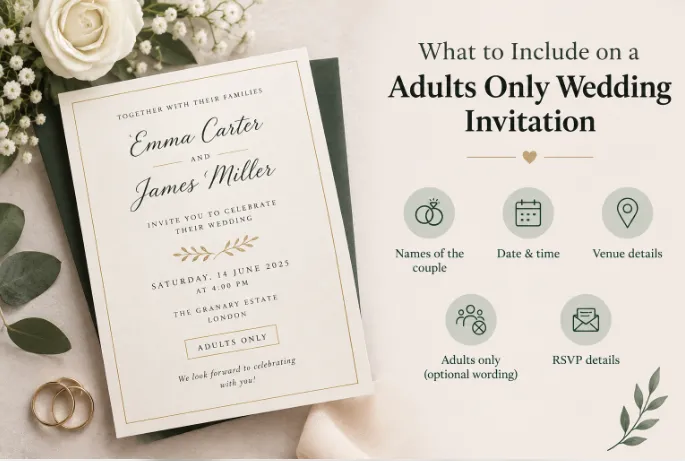
Before the child-free message, make sure the invitation covers the basics. Missing details are the main reason guests text you.
Names of the Hosts and the Couple
The top of the invitation says who is inviting guests. If your parents are hosting, their names come first, followed by a line such as “request the honor of your presence at the marriage of.” If you’re hosting yourselves, your names alone are enough. If both sets of parents are contributing, you can list all of them or use a neutral line such as “together with their families.”
Use the same spelling and the same level of formality on every piece of stationery. If the invitation says “Katherine” and the website says “Katie,” some guests will wonder whether they have the right event.
Date, Day of the Week, and Start Time
Write the day of the week with the date, for example “Saturday, September 12.” Put the ceremony start time, and consider writing “Guests are requested to be seated by 4:30 PM” if you want people there early. A common practical trick is to print a start time 15 to 20 minutes before you actually plan to begin, because some guests will always arrive late.
Venue Name and Complete Address
Include the venue name, street address, city, and state. If the ceremony and reception are in different places, list both or put the second on the details card. Add a line if parking is limited or if the venue is hard to find. A one-line note such as “Enter through the north gate” saves you a lot of phone calls on the day.
Indoor or Outdoor Information
Guests dress differently for a garden ceremony than for a hotel ballroom. If any part of the event is outdoors, say so, and give a backup plan: “In the event of rain, the ceremony will move indoors.”
Reception Details
State what guests can expect, because it affects whether they eat beforehand. Use plain language:
- “Dinner and dancing to follow”
- “Cocktails and appetizers to follow”
- “Reception immediately following”
Dress Code
Dress code is one of the most searched wedding invitation questions, and the answer is often missing. Print it clearly. Common options and what they mean in practice:
- Black tie: floor-length gowns and tuxedos
- Black tie optional: tuxedo or dark suit, long or formal cocktail dresses
- Cocktail attire: knee-length dresses, suits, ties optional depending on region
- Semi-formal or dressy casual: a suit without necessarily a tie, a nice dress or separates
If your guest list includes people unfamiliar with these terms, add a one-line explanation on the website.
RSVP Deadline and How to Reply
State the reply-by date and exactly how to respond: mail the card, visit the website, or scan a QR code. Offer a backup for guests who don’t use the internet, such as a phone number or an email address.
Website Address
Put your wedding website on the invitation, even if the content is minimal. It becomes the place where everything that doesn’t fit on paper lives, including your child-free policy explained in a friendly way.
Where the Adults-Only Message Should Go
There is a real debate here, and it’s worth knowing about before you print anything.
What Etiquette Traditionalists Say
Traditional etiquette says the invitation itself shouldn’t carry instructions or restrictions. In that view, the envelope addressing is the message: if children’s names aren’t on it, they aren’t invited. The reasoning is that it feels awkward for a formal invitation to say who isn’t coming.
What Works in Practice
In real life, many guests don’t read envelope addresses closely, and some assume “and family” without checking. For that reason, most couples who go child-free state it in writing in at least one place beyond the envelope. You don’t need to choose between etiquette and clarity. You can honor the traditional method and add a simple line on a secondary piece such as the reception card, details card, or website.
A practical rule: the invitation itself carries the minimum, the details card carries the clear statement, and the website carries the full explanation.
Placement Options and When to Use Each
On the main invitation: Use this for very casual weddings or when you have many guests with young children and you’ve already had problems. Place the line at the bottom, in smaller type.
On the reception card: This is the most common spot for a printed policy. It sits next to the details guests are already reading, such as time and place.
On the details or information card: This is the best choice for most couples. You have space to be warm, give childcare tips, and explain without cluttering the invitation.
On the website only: Fine if you also address envelopes correctly and your guest list is small and close. Risky for large lists, because not every guest visits the website.
In person or by phone: Always do this for close family and friends who have children, in addition to any printed message.
Wording That Works: Copy and Adapt
Here is wording you can use directly, grouped by how formal your wedding is.
Short Lines for the Invitation or Reception Card
- “We respectfully request an adults-only celebration.”
- “Please note: this will be an adults-only event.”
- “Adult guests only, please.”
- “We kindly ask that this be a celebration for guests aged 18 and over.”
- “While we adore your little ones, we have chosen to host an adults-only celebration.”
A Slightly Longer Version for the Details Card
“We have chosen to celebrate our wedding with adult guests only, and we hope you’ll enjoy a night out. If you’re traveling with children and need help finding a sitter, please see the Travel page on our website.”
A Version for Guests Traveling With Kids
“We know that arranging childcare can take planning, so we wanted to let you know early. Our wedding will be adults-only. A list of local sitters and hotel childcare options is on our website.”
Wording When Children Attend Only Part of the Day
If kids are welcome at the ceremony or a daytime event but not the evening reception, say so explicitly:
“Children are warmly welcome at the ceremony. The reception that follows will be adults-only.”
Without that clarification, parents will assume that “reception” means the whole day or will not know whether to bring the children to the ceremony at all.
Wording to Avoid
- “No kids” or “No children allowed”: accurate, but it reads like a venue sign.
- “Adult reception”: guests sometimes read this as a themed party, not a child-free event.
- “Due to budget constraints...”: explaining the reason invites guests to offer solutions (“I’ll pay for my kids’ meals!”). A short statement leaves no negotiating point.
- “Sorry, no children”: it sounds like you regret your own decision.
- “Adults only” on the outer envelope: the outer envelope is for the address only.
Addressing Envelopes So the Message Is Clear
Envelope addressing is your quietest and most traditional tool, and most guides skip the specifics.
The Rule: Only Named People Are Invited
The names written on the envelope define who is invited. If the envelope reads “Mr. and Mrs. David Torres,” the invitation is for those two adults. “The Torres Family” or “Mr. and Mrs. David Torres and Family” tells guests that children are included. So never use “and family” on an adults-only invitation.
Single Envelope Invitations
Most modern invitations use a single envelope, which leaves you only one line to work with. Write the names of each invited adult in full: “Mr. David Torres and Mrs. Elena Torres” or “David and Elena Torres.” If you’re inviting a household with adult children, list each by name on separate lines.
Double Envelope Invitations
If you use an outer and inner envelope, the outer envelope carries full names and the address, while the inner envelope carries just the names of the people invited, such as “Mr. and Mrs. Torres.” Inner envelopes never include children’s names when the event is adults-only.
Households With Adult Children
If a household includes a 19-year-old son, he should get his own invitation if he’s invited. Don’t rely on a parent’s invitation to cover him unless his name is on it.
Guests Under 18
If some guests under 18 are invited (for example, a teenage cousin), either address them on the envelope or send them their own invitation. Put “Miss Julia Torres” or “Mr. Ben Torres” on the line below the parents’ names, and be sure the age cutoff on your details card matches.
Never Rely on the Envelope Alone
Treat envelope addressing as your base layer. Add the printed line, the RSVP setup, and the website message on top.
Setting Up the RSVP So Guests Can’t Misread It
The RSVP is where most child-free policies break down, because it’s the one piece guests actually fill in.
Pre-Print the Names on Paper RSVP Cards
Instead of leaving a blank line for guest names, print or handwrite the invited names directly on the card:
“The favor of a reply is requested by August 10
Elena and David Torres
☐ Joyfully accepts ☐ Regretfully declines”
When the names are already there, there’s no space to add anyone else. This is the single most effective step for an adults-only wedding.
Use the “Seats Reserved” Line
Another proven method is to print: “We have reserved ___ seat(s) in your honor.” Fill in the number by hand before mailing. A guest who sees “2” understands immediately that the invitation covers two people.
Remove Open “Number Attending” Fields
Avoid a blank line for “Number of guests attending.” It invites guessing.
Set Up the Website RSVP Properly
If your RSVP is online, configure it as follows:
- Build your guest list in the website tool with each household’s invited members only.
- Make sure the form shows invited names with an accept or decline option for each, rather than a free-text box for adding guests.
- Test the form yourself before launching by using a sample household.
- Check whether the tool lets guests add a plus-one or additional names, and turn that setting off unless you intend it.
Most major wedding website platforms let you control these settings. Check the guest list or RSVP settings in whichever platform you use, because the options and where they live differ from platform to platform.
Include Accessibility and Dietary Fields
Adding a short question about dietary restrictions or mobility needs makes the RSVP useful to your caterer and venue, and it reassures guests that you’ve planned for them.
Count RSVPs Against Your Master List
Keep a spreadsheet with columns for household name, invited names, invited count, RSVP status, and reply count. When a reply arrives with a count that doesn’t match, you’ll notice immediately and can contact the guest the same day rather than discovering the mismatch at the final headcount.
Plus-Ones and the Rest of the Guest Policy
Child-free weddings and plus-one decisions often come up together, so put your policy in order before printing.
Decide on a Simple Rule
Choose one clear rule and apply it. The most common ones are:
- Everyone gets a plus-one.
- Plus-ones for married, engaged, or long-term couples only.
- No plus-ones, with guests invited by name only.
Rules based on relationship status are easier to defend than rules based on how close you are to each guest.
Show the Rule on the Envelope
“Ms. Taylor Reed and Guest” invites a plus-one. “Ms. Taylor Reed” alone does not. That is the standard convention, and guests tend to understand it.
State It on the Website
Add a line to your FAQ page: “Due to venue capacity, we’re unable to accommodate additional guests beyond those named on the invitation.” This covers both the plus-one question and the children question in a single neutral sentence.
Deciding Who Counts as an Adult and What Exceptions to Make
The hardest parts of a child-free wedding are the edge cases. Decide on these before you send anything, because inconsistency, not the policy itself, is what causes hurt feelings.
Choose an Age Cutoff
“Adults only” is vague. Does a 16-year-old count? Many couples choose 18 as the cutoff. Some choose 21 for events with a bar. Write it down as a number: “Guests must be 18 or older.” If a relative is 17 and you want to include them, handle that individually with a personal conversation, not a general announcement.
Children in the Wedding Party
Flower girls, ring bearers, and junior attendants are the most common exceptions. Guests generally accept this. To avoid confusion:
- Tell the parents of those children exactly which events their child is included in (ceremony only, photos, reception).
- Plan who will supervise them during the reception, since you’ll be busy.
- Decide whether the children’s siblings are invited. If not, tell the parents directly.
Infants
Infants are the exception couples most often overlook. A nursing mother may not be able to attend without her baby. Common approaches include:
- No exceptions: simplest and most consistent.
- Infants under a specific age (for example, “babies who are not yet crawling”): easy to explain, but you must apply it to everyone.
- Case-by-case, handled privately: flexible, but riskier, because guests may compare notes.
Whichever you choose, decide before invitations go out. If you make an exception, tell the parent directly and ask them to keep arrangements low-key. It’s usually wise to also let your venue and caterer know that a baby may be present.
Your Own Family’s Children
If your siblings or cousins have children, the policy has to apply to them too. Making an exception for your own family while excluding friends’ children is the most common source of resentment. If you want to include nieces and nephews, expect friends to notice, and be ready with a clear, honest reason rather than a vague one.
Out-of-Town Family
If someone is flying in with children, the question becomes practical: where do the children stay while the parents are at the wedding? A sitter service at the hotel or a relative who is not attending the event solves this. Raise the question with the family early so they can plan.
What to Put on the Details Card for Parents
Adults-only weddings ask parents to arrange childcare. The details card is where you make that easier.
Exact Start and End Times
Parents book sitters by the hour. Print the ceremony start and the reception end, for example, “Reception concludes at 11:00 PM.” If the schedule changes, update your website and tell guests where to look.
Local Sitter Options
If you know of reliable sitter services or local babysitters, list them. If you don’t, ask your venue, hotel concierge, or planner for recommendations. Many hotels have a list of vetted sitters or a partner childcare agency. Don’t list individuals you haven’t verified, and never imply that you personally guarantee anyone’s reliability.
Hotel Block and Shuttle Information
If guests are staying at a hotel, include booking instructions and the block deadline. Shuttle schedules matter even more for parents who need to return for a sitter at a set time.
On-Site Childcare: What to Consider
Some couples arrange a supervised kids’ room at the venue, typically run by a licensed childcare provider. If you’re considering this, check the following first:
- Does the venue allow it, and is there a separate room away from the reception?
- Is the provider licensed, insured, and background-checked?
- Who is responsible if a child gets hurt?
- What does it cost, and who pays?
- Will you be technically hosting a children’s event, which changes the “adults-only” description of your wedding?
This is a bigger commitment than a printed line, so it works best for destination weddings where parents have no local options.
Timeline: When to Send Each Piece
Timing matters because parents need advance notice for childcare.
Save-the-Dates
For a local wedding, send save-the-dates six to eight months ahead. For a destination wedding or one over a holiday weekend, send them eight to twelve months ahead. You don’t have to state the child-free policy on the card, but include your website address so that guests with children can find the explanation early.
Invitations
Mail invitations six to eight weeks before the wedding for local events, and eight to twelve weeks before for destination weddings. For couples sending to large guest lists across several time zones, closer to the early end of that range is safer.
RSVP Deadline
Set the RSVP deadline three to four weeks before the wedding. Check with your caterer about when they need a final headcount. Many caterers ask for it one to two weeks ahead, so a deadline that’s too late leaves no room to chase missing replies.
Follow-Up Window
Begin chasing late responses the day after the deadline. Send a short, friendly text or email to each guest who hasn’t replied. Don’t leave it for a week.
Personal Conversations
For close relatives and friends with young children, call or visit before the invitations are mailed. A short conversation shows respect and prevents the shock of finding out from a card.
Scripts for Common Awkward Moments
Having your answers ready lets you stay calm and consistent.
When a Guest Asks, “Can I Bring My Kids?”
“We’d love to have you there, but we’ve decided to keep the celebration adults-only. We hope you can still join us, and I’m happy to share some sitter recommendations.”
When a Guest Says They Can’t Come Without Their Children
“We completely understand, and we’ll miss you. We’d love to celebrate with you another time.”
Don’t try to persuade them, and don’t apologize for the policy.
When a Guest RSVPs With Children Included
Contact them privately within a day of receiving the reply:
“Thanks so much for your RSVP! Just a reminder that our wedding is adults-only, so we’ve only reserved seats for you and [partner’s name]. We’re really looking forward to seeing you.”
Use a call or a one-to-one message. Avoid group chats and public comments.
When a Family Member Argues
If a relative pushes back, remain polite and repeat the same answer:
“I hear you, and I understand it’s not easy. We made this decision for the whole guest list, so we can’t make exceptions.”
A repeated, calm answer is more effective than a long explanation.
When Someone Asks for an Exception for a Baby
“Let me think about it and get back to you.” Then decide based on your policy. If you say yes, tell them clearly which conditions apply (for example, “the baby can come, but not other children”).
When Guests Show Up With Children Anyway
This is rare if you’ve used several communication methods, but plan for it:
- Assign a trusted person, not yourselves, to speak to the guest quietly at the door.
- Offer a practical solution: a nearby hotel, a relative who can watch the children, or a nearby sitter.
- Ask your caterer whether adding a seat is possible if you decide to accommodate the situation. Doing this at the last minute can cost extra and may not be possible.
Appoint a Point Person
Ask a sibling, close friend, or planner to be the contact person for guest questions. Give them a short sheet of answers so guests receive the same information from everyone.
What to Say on Your Wedding Website
A website FAQ is where you can be warm without being wordy. Here is wording you can copy.
Sample FAQ Entry: Children
Are children invited?
We love your little ones, but we have chosen to host an adults-only celebration. We hope this gives parents a night out. If you’re traveling with children, please see our Travel page for a list of sitter recommendations.
Sample FAQ Entry: Plus-Ones
Can I bring a guest?
Your invitation lists everyone invited. Due to venue capacity, we’re unable to add additional guests.
Sample FAQ Entry: Wedding Party Children
Will any children be attending?
Children who are part of our wedding party will be present for the ceremony and photos. Their families have details about the rest of the day.
Sample FAQ Entry: Infants
What about babies?
If you have a nursing infant and are unsure about attending, please contact [name] directly and we’ll talk it through.
Be sure the website matches the invitation wording exactly. Different phrasing across pieces creates doubt about which one is accurate.
Digital and Emailed Invitations
Some couples send digital invitations, which require a few adjustments.
Place the Message Near the Top
Readers skim emails. A child-free note buried in the footer is easy to miss. Put it in the first paragraph or in a bold line directly under the event details.
Personalize Each Message
Send each household its own email or link with only the invited names. Mass emails make it hard to control who is included.
Test on a Phone
Most guests will open the invitation on a phone. Check that the text is readable, the RSVP button works, and the child-free line is visible without extra scrolling.
Keep a Printed Option
Some older relatives prefer paper. Send a printed version to those guests, and match the wording to the digital invitation.
Adults-Only Wedding Planning Details Beyond the Invitation
A few related decisions affect how well your policy works on the day.
Check Your Venue’s Rules
Some venues have their own age policies, particularly when alcohol is served. Others have restrictions on who may enter certain areas, such as a bar, clubhouse, or golf course facility. Confirm with the venue coordinator that your policy aligns with theirs, and ask about their capacity and headcount deadlines. This matters especially if you’re hosting at a sports club, a stadium suite, or a racecourse, where age limits and licensing rules may apply independently of your preferences.
Match the Schedule to the Message
An evening ceremony followed by dinner and dancing signals an adult event more naturally than a mid-morning ceremony. Parents also understand that a late evening is a poor fit for young children.
Tell Your Vendors
Let your caterer, planner, and venue coordinator know the policy so they don’t prepare children’s meals or ask guests about kids’ seating. If you’ve made exceptions, tell them which ones.
Consider a Separate Event for Families
Some couples hold a casual brunch or welcome gathering where children are invited. This gives families a chance to celebrate with you without having to leave the kids at home for the whole weekend. State the guest rules separately for each event on your website.
Final Checklist Before You Print
- Hosts, couple names, and request line are included.
- Day, date, and start time are clear.
- Venue name and full address are listed, including any second location.
- Reception style (dinner, cocktails, dancing) is stated.
- Dress code is printed.
- The adults-only line appears on at least one printed piece.
- Envelopes list only invited guests, with no “and family.”
- The RSVP card has pre-printed names or a “seats reserved” line.
- The online RSVP is configured to show invited names only.
- The age cutoff is decided and consistent across all guests.
- Exceptions (wedding party, infants) are decided and communicated personally.
- Plus-one policy is clear on the envelope and website.
- Details card includes end time, sitter options, and travel information.
- Website FAQ matches the invitation wording.
- A point person is chosen to answer guest questions.
- A master spreadsheet is set up to track every household and reply.
Frequently Asked Questions
Is it rude to have an adults-only wedding?
No. The guest list is yours to decide, and a child-free policy is a common choice. What matters is how you communicate it: early, kindly, and consistently with everyone.
Where do you put “adults only” on a wedding invitation?
Most couples put it on the reception card or details card, or at the bottom of the invitation in smaller type. Pair it with careful envelope addressing and a website FAQ so the message is repeated in more than one place.
How do you politely say no kids on a wedding invitation?
Use a warm, brief line such as “We respectfully request an adults-only celebration” or “While we adore your little ones, this will be an adults-only event.” Avoid “no kids allowed.”
How do you address an envelope for an adults-only wedding?
Write only the names of the invited adults. Don’t use “and family” or “The Smith Family.” For households with adult children who are invited, list each by name.
What does “adult reception” mean on an invitation?
Traditionally it signals that the reception is for adults, but many guests misread it as an event with adult themes. A clearer phrase such as “adults-only celebration” avoids this confusion.
What age should I use for an adults-only wedding?
Most couples use 18. Some use 21 if alcohol is a major part of the event. Whichever you choose, write the number on your details card or website so nobody has to ask.
Can I invite children to the ceremony but not the reception?
Yes. State it plainly, for example: “Children are welcome at the ceremony. The reception is adults-only.” Parents then know whether to bring the children for one part of the day and arrange childcare for the rest.
Should I include the child-free policy on the save-the-date?
You don’t have to print it, but you can add your website address so parents can read the policy early. This is especially helpful for destination weddings or events held over holiday weekends.
How do I stop guests from adding their kids on the RSVP?
Pre-print the invited names on the card, or use a “seats reserved” line that you fill in by hand. For online RSVPs, set up each household with only the invited names and avoid free-text guest fields.
Can I make an exception for a baby?
Yes, many couples do, especially for nursing infants. Decide on a simple rule before invitations go out, such as “babies under a certain age,” and communicate any exception directly to the parents involved.
Should I offer childcare at an adults-only wedding?
You aren’t required to. Offering a sitter list, hotel recommendations, or a vetted childcare service is a considerate gesture, and it’s most useful for guests traveling from out of town.
What do I say if a guest brings children anyway?
Have a trusted person, not you, speak to the guest privately and calmly. Offer a practical solution, such as a sitter nearby or a relative who can take the children, and ask your caterer whether adding a seat is possible.
Should my relatives’ children be excluded too?
For fairness, yes. If you make exceptions for your own family, other guests will notice. If you do want to include certain children, be ready to explain your reasoning honestly.
How far in advance should I tell guests about the policy?
As early as possible. Share it on your website when you send save-the-dates, and call close family members with children before the invitations arrive. Parents often need several weeks to arrange childcare.
Do plus-ones count in an adults-only wedding?
They’re a separate question. Address the envelope to “Name and Guest” if you’re offering a plus-one, and to the guest’s name alone if you’re not. Be consistent across the guest list.
Final Thoughts
Having an adults-only wedding doesn’t require a perfectly worded sentence. It requires a consistent system. Print a short, kind line on one piece of your stationery, address every envelope to named guests only, pre-fill the RSVP so there’s no room for guesswork, and explain the details on your website. Tell close family personally before the invitations arrive, give parents what they need to plan childcare, and have a short script ready for the guests who still ask.
When each piece of your invitation suite says the same thing, most guests understand your plan without a conversation, and the few who do ask can be answered quickly and kindly.