
Most wedding advice assumes the couple wants a grand entrance, a choreographed first dance, a long head table and a room of eyes on them all night. If that picture makes your stomach drop, the standard advice was not written for you, and you are in good company. Plenty of couples dread the reception more than the ceremony. It is not ingratitude. Being watched while you eat, dance and smile is simply draining.
Here is what most articles skip: attention at a wedding is not one constant thing. It arrives in a few short, predictable bursts, and almost every burst can be shortened, moved, shared or removed without guests feeling cheated. This guide shows you how to find your own pressure points, choose a format that spreads attention across the room, rework every traditional spotlight moment, brief family and vendors with exact wording, and build a night where you are present, fed and actually enjoying your own party. It also includes game-day, tailgate and activity-style ideas for sports-loving crowds.
Why Many Couples Dislike Being the Center of Attention (and What Actually Triggers It)
"I hate attention" is too vague to plan around. What bothers you decides which fix works, so start by naming the real trigger.
The Four Kinds of Wedding Attention
Most discomfort falls into one of four buckets. Many couples have two of them at once.
- Performance attention: you must do something while people watch, such as dancing, cutting a cake, or giving a speech. The fear is looking awkward.
- Evaluation attention: nothing is asked of you, but you are being looked at and judged, such as walking in, sitting at a head table, or posing for photos. The fear is being assessed.
- Emotional attention: people say moving things about you and expect a visible reaction, as with toasts or a father-daughter dance. The fear is not knowing how to react, or crying on camera.
- Social-load attention: you must talk to a very large number of people, often repeating the same small talk. The fear is running out of energy, not being watched at all.
This matters because the fixes are different. A private first dance solves performance attention but does nothing for social load. A quiet retreat room solves social load but does nothing for a toast. Match the fix to the trigger.
Shy, Introverted or Anxious: Know Which One You Are
Introverts usually enjoy people but lose energy in crowds, so they need recovery time and a shorter night. Shy people fear judgment, so they do better with an activity or a task that gives conversation a natural anchor. People with social anxiety often feel physical symptoms such as a racing heart, shaking hands, or dread that starts days ahead, and they benefit most from predictability: a written run-of-show, no surprises, and a trusted person managing logistics. If anxiety is intense or affects daily life, a short conversation with a therapist before the wedding can be one of the best investments in the whole budget.
The Spotlight Audit: Score Your Own Dread
Before you change anything, run this ten-minute exercise. Each of you privately scores every moment from 0 (no problem) to 5 (I would skip the wedding to avoid it). Then compare. Where your scores differ by two points or more, plan around the higher score.
| Moment | Typical time in the spotlight | Attention type | Your score (0-5) |
|---|---|---|---|
| Grand entrance | 1-2 min | Evaluation | |
| First dance | 3-4 min | Performance | |
| Cake cutting | 2-5 min | Performance | |
| Toasts | 10-25 min | Emotional | |
| Head table dinner | 45-90 min | Evaluation | |
| Receiving line | 15-30 min | Social load | |
| Parent dances | 3-8 min | Emotional | |
| Bouquet and garter | 5-10 min | Performance | |
| Formal photos with guests | 20-45 min | Evaluation | |
| Grand exit | 2-5 min | Evaluation |
Notice what the table shows: the longest exposures are usually the quiet ones, like sitting at a head table or standing in a receiving line, not the famous moments. Couples often fix the first dance and forget that an hour at a stage-like table is the real source of strain. Any item you score 3 or higher goes on your "change it" list for the rest of this guide.
The Attention-Budget Method: Four Rules for Designing the Whole Night
Instead of fixing moments one at a time, give the reception an attention budget. Think of it as the total minutes you will spend as the focal point of the room. A traditional reception can quietly add up to well over an hour. A low-spotlight reception can bring that under fifteen minutes without losing anything guests care about. These four rules do most of the work.
Rule 1: Shorten, Share, Shift or Skip
Every spotlight moment can be handled in one of four ways, and the right one depends on how much the moment matters to you.
- Shorten: keep it but cut it to 30-90 seconds, such as a first dance that fades into a group dance.
- Share: bring other people into it so you are one of many, such as inviting the dance floor to join on the second verse.
- Shift: move it somewhere with fewer eyes, such as cutting the cake privately or doing the first dance before guests arrive.
- Skip: drop it entirely, such as the garter toss or the grand entrance.
A useful test: if you are only doing something because "people expect it," skip it. If you want the meaning but not the audience, shift or share it.
Rule 2: Put Attention on a Task, Not on You
People look at what is happening. If guests are queuing at a taco bar, playing cornhole, or watching a game, the room has a focal point that is not you. This is the single most effective psychological shift in the guide: you do not hide from attention, you give the crowd something better to look at.
Rule 3: Keep the Hosting Role Light and Moving
Standing still in the middle of a room invites staring. Moving from table to table, holding a drink, or helping a grandparent to a seat makes you part of the flow. Plan to circulate for the first thirty minutes, then settle with your people. Movement also gives you a natural exit from any conversation you want to leave.
Rule 4: Protect Recovery Time Like a Vendor
Book recovery time the same way you book a photographer. Put two ten-minute breaks into the run-of-show, name the room where you will take them, and tell your point person. Couples who schedule recovery rarely need it urgently, and couples who do not schedule it often hit a wall around hour three.
Reception Formats Ranked by How Exposed You Feel
The format you pick sets how much attention you carry before a single tradition is considered. This table compares the most common options for couples who want a low profile.
| Format | Spotlight exposure | Best for | Watch out for |
|---|---|---|---|
| Cocktail-style standing party | Very low | Introverts, mingling-loving crowds | Older guests need enough seats |
| Restaurant buyout or private dining room | Low | Guest lists under 60 | Minimum spend and fixed menus |
| Backyard or garden party | Low | Relaxed, DIY-friendly couples | Weather plan, rentals, cleanup |
| Daytime brunch or lunch | Low | Early finishes and lower budgets | Fewer dance-focused guests |
| Family-style long tables | Medium | Warm, talkative families | Seating politics at shared tables |
| Activity venue (bowling, mini golf, ballpark suite) | Very low | Sports fans, mixed-age groups | Noise and limited formal dining |
| Traditional plated dinner with head table | High | Couples who want formality | Long stretches on display |
Cocktail-Style Reception
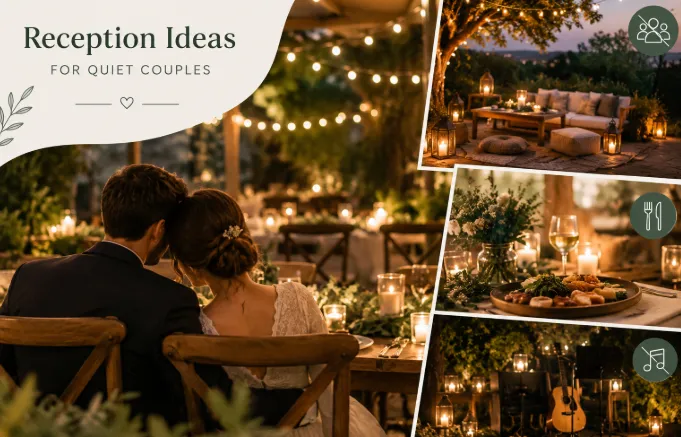
A cocktail format removes the room's single focal point. Guests stand in small groups, food comes to them, and nobody is waiting for the couple to do anything. Plan for seating for roughly two-thirds of your guests, with extra chairs for older relatives and anyone with mobility needs, and place lounge seating near the bar so no one feels stranded. Offer substantial food, such as carving stations, sliders and small bowls, so guests do not leave hungry. Ask your caterer for a realistic per-person count of bites per hour.
Family-Style Dinner at Long Tables
Passing platters creates constant small tasks: hand the salad, pour the water, pass the bread. These tasks keep conversation moving between guests so they are not looking at you. Sit in the middle of a long table rather than at the end, which keeps you inside the group instead of presiding over it.
Restaurant Buyout or Private Room
A private room is naturally small, warm and lower-pressure. Many restaurants will skip dance floors and DJs entirely, which removes two spotlight generators at once. Ask about the minimum spend, the room's hard end time, and whether you can bring in a cake or desserts from outside.
Backyard or Garden Party
Outdoor layouts with multiple zones, such as a drinks table, a lawn game area, a fire pit and a dessert corner, spread attention across the property. Plan for restrooms, lighting, and a rain plan before you plan decor. A tent with open sides keeps the party connected to the yard rather than boxed in.
Brunch or Afternoon Reception
Daytime events feel casual by default. Guests expect an earlier end, lighter food and less pressure to dance. A coffee bar, a mimosa station and a build-your-own pancake or waffle table give guests a focus. Many couples find that a three-hour brunch delivers the same emotional payoff as a seven-hour evening, with a fraction of the social load.
Game-Day or Tailgate-Style Reception
If you and your guests love sports, this format is one of the strongest attention-diverters available. Set up a large screen, serve ballpark-style food, encourage team colors and add casual games. The room faces the screen and the action, not the couple. Two rules keep it from going wrong: first, confirm that guests who are not sports fans have plenty of other things to do, and second, plan your audio so the game never drowns out conversation, with captions on and sound low except for key moments. If you want to build around a specific event, check the broadcast schedule well in advance and have a backup plan if the game runs long or is moved.
Activity Venue Reception
Bowling alleys, mini golf courses, pickleball clubs and ballpark event spaces give guests a built-in activity from the moment they arrive. People who are playing do not wait for the couple to perform. Ask the venue about a private area, food and drink packages, and whether they have a quiet space for toasts or cake.
How to Rework Every Traditional Spotlight Moment
You can keep what each tradition means without the audience. Here is how to handle each one, with the specific logistics most articles leave out.
The Grand Entrance
The announced entrance is the easiest moment to remove. Tell your DJ or host in writing: no name announcement, no entrance song, no spotlight. Then pick a replacement.
- Arrive with the guests. Come straight from photos into cocktail hour, and the party is already underway.
- Slip in during music. After guests are seated, walk in while background music plays, with no introduction.
- Host-led "dinner is ready." Ask a friend to say that dinner is open and to invite everyone to find their seats. Nobody looks at you because the announcement is about food.
If you are worried the room will go quiet and stare as you walk in, enter with a small group, such as the wedding party or your parents, and keep walking to a table that already has people at it.
The First Dance
The first dance is stressful because it combines performance, an audience and a fixed length. Take each of those apart.
- Make it private. Do it before guests arrive or during portraits with only your photographer present. Ask your DJ to play the real song so the audio is usable in your video, and ask your photographer to capture a few wide shots to show the setting.
- Make it short. Choose a song, then ask the DJ to start the track at a strong section and fade by about 60 to 90 seconds. Agree on a hand squeeze as your cue.
- Make it shared. Ask your DJ to invite everyone onto the floor at the second chorus. A full floor makes you invisible, and guests usually enjoy being invited.
- Make it a slow song for everyone. Some couples play a slow song and call all couples to dance, honoring the longest-married pair first.
Practical tip: take one lesson or watch a few videos so you know a simple sway and one turn. Having a plan for your hands and feet removes most of the awkwardness.
Cake Cutting
The cake cutting is a photo opportunity, not an obligation. If you want the photo, do it during cocktail hour when the room is busy, or right after dinner with only family nearby, and keep it to ten seconds. If you do not, have the cake sliced in the kitchen and served as dessert. Tell your caterer so they do not wheel it out dramatically.
Toasts and Speeches
Sitting still while people praise you is a unique kind of discomfort. Section "Speeches Without the Squirm" below covers speaker briefs and formats in detail. In short: keep toasts to two or three speakers, place them during dinner, and brief speakers to address the room.
Parent Dances
Parent dances can be touching and exposing at the same time. Alternatives include a short dance with both parents at once, a combined parent and family dance, a private moment before the reception, or a quiet photo and a hug instead of a dance. If a parent really wants the dance, offer a short version and let them pick the song.
Bouquet and Garter Tosses
The garter toss is optional and often feels dated. For the bouquet, replace the toss with a presentation: give it to the longest-married guest, a grandmother, or a friend who helped you. This turns an awkward group moment into a warm one-on-one.
The Receiving Line
A formal receiving line puts you on display for 15 to 30 minutes and forces repeated small talk. Table visits are better. Visit each table during the first course, spend two minutes at each, and ask a question that invites stories, such as "How did you two meet?" For a larger guest list, split the work: you take half the tables and your partner takes the other half, then meet in the middle.
The Grand Exit
The staged send-off, with sparklers or bubbles, asks guests to line up and look at you. Alternatives: leave quietly after the last dance, slip out with a few close friends, or end the night with a group photo and an all-guest toast so the finale belongs to everyone. If you want a photo of the moment, do a private mini-exit just for your photographer after the party.
Seating, Room Layout and Sightlines That Keep You Out of the Focal Point
Where you sit and how the room is arranged shape how visible you feel more than almost any tradition. Most venues default to a layout that points every chair at the couple. You can change that with a few instructions.
Replace the Head Table
A long head table lines you up like a panel and keeps you facing guests while you eat. Better options:
- A round table with close people. You sit at a regular table with your parents, wedding party or best friends. You get conversation instead of stares.
- A sweetheart table off to the side. A small table for two near a wall or window gives you a private meal. Place it where guests can wave, but not where they face it all night.
- A long communal table. You sit in the middle, not the end, as one of many.
If your venue insists on a particular layout, ask for the table to be angled toward the room's side wall rather than the dance floor. This breaks the direct sightline from most seats.
Read the Room's Sightlines
Walk the venue and stand where each element will be: the dance floor, bar, DJ, buffet and your table. Notice which chairs face you directly. Ask the planner to angle those tables so guests face each other or the activity, not you. Avoid placing your table in the center or directly opposite the entrance.
Create a Quiet Retreat
Set aside a small room, patio, or corner with two chairs, water, snacks and a phone charger. Tell one trusted person where it is. A retreat has the biggest payoff of any single feature because it turns an overwhelmed moment into a ten-minute reset. Make it easy to reach without walking through the whole room.
Plan Table Sizes and Seating Politics
Round tables of eight create small conversations and make guests feel included. Seat difficult relatives apart, place talkative friends near shy ones, and put your own table near the people you love most. Add table numbers rather than elaborate place cards, which reduces the pressure of finding a seat in front of everyone. If you are using family-style service, seat people who know each other at the same table so passing platters stays easy.
Make It Easy for Guests to Move
Add a few high-top tables, lounge seating and standing spots so guests can wander. A room full of people sitting in rows looks at the same point. A room where people stand and circulate has no point to look at.
Pacing the Night: Run-of-Show Schedules Built Around Your Energy
A reception schedule is usually designed around vendors and traditions. A low-spotlight schedule is designed around your energy and the guests' comfort. The principles below come first, followed by two schedules you can copy.
Pacing Principles
- Front-load the social part. Your energy is highest at the start. Do greetings and table visits early, then settle in.
- Leave gaps. A schedule with no buffer forces you to be "on" continuously. Plan 15-minute gaps between blocks.
- Put the emotional moments in the middle. Toasts and any parent moments land best once guests have eaten and relaxed, but before they are tired.
- End while it is still fun. An end time when guests are still dancing creates a better memory than an extra hour of drift.
- Give vendors the schedule. Send the final run-of-show to your DJ, caterer, photographer and venue coordinator a week before, and bring printed copies.
Schedule 1: Four-Hour Cocktail-Style Reception
| Time | What happens | Spotlight level |
|---|---|---|
| 5:00 pm | Guests arrive, lawn games and passed bites begin | None |
| 5:20 pm | You join the party quietly after portraits | Low |
| 5:20-6:10 pm | Greet guests as you circulate, no receiving line | Low |
| 6:10 pm | Food stations open, you eat with close friends | Low |
| 6:45 pm | Ten-minute recovery break in the retreat room | None |
| 7:00 pm | Two short toasts during dinner | Medium |
| 7:30 pm | Cake served as dessert, no ceremony | None |
| 7:45 pm | Group dance opens, short first dance fades into a full floor | Medium |
| 8:30 pm | Second recovery break, then open dancing and games | None |
| 9:00 pm | Quiet exit or last dance with everyone | Low |
Schedule 2: Three-Hour Brunch Reception
| Time | What happens | Spotlight level |
|---|---|---|
| 11:00 am | Guests arrive to coffee, mimosas and a light spread | None |
| 11:30 am | Seated brunch with family-style platters | Low |
| 12:15 pm | One toast from a parent and one from a friend | Medium |
| 12:30 pm | Ten-minute break | None |
| 12:45 pm | Dessert table, photo station and games open | None |
| 1:30 pm | Table visits and goodbyes | Low |
Schedule 3 Idea: Game-Day Reception
If you are building around a televised game, ask a friend to track the broadcast schedule and pin the key moments to your timeline. Place the toast during a break in play, not during a key moment. Put food stations away from the screen so people who are not watching can still talk. Keep sound low and captions on so conversation remains possible, and have a plan for what happens if the game runs long.
Activities and Sports-Style Ideas That Give Guests Something to Do
Guests stare at the couple when there is nothing else to do. Remove the vacuum and the staring goes with it. These ideas work as attention-diverters, and many suit sports-loving crowds in particular.
Lawn Games and Active Stations
Cornhole, giant Jenga, bocce, ring toss, mini putting greens, badminton and table tennis cover most age groups. Indoors, foosball, darts, shuffleboard and a mini basketball hoop work well. Place games in clusters, not in one corner, so there are several centers of activity. Assign a friend to keep score sheets and rules at each station so you are never asked to explain them.
A Reception Bracket or Pick-Em Pool
Hand every guest a card at the start, with a short bracket of couple-themed matchups, such as "Who said I love you first?" or "Who is the better driver?", plus a few real predictions if a game is on. Guests fill it out, compare, and chat. The winner gets a small prize. This gives people a shared topic that is not you in person.
Backyard-Olympics Mini Tournament
Set up a three-event tournament with teams drawn from table numbers: cornhole, ring toss and a relay or trivia round. Keep rounds under ten minutes. A winner's trophy, even a silly one, gives the crowd a reason to cheer something other than the couple.
Watch-Party Corners
If a big game falls near your date, set up one corner with a screen, comfortable seating and snacks. Guests who care can watch, while others stay in the main room. This keeps both groups happy and prevents the whole party from tilting toward the screen.
Table Trivia and Games
Place trivia cards, conversation starters or a question-and-answer game on each table. Team-based trivia works because no one is called on individually, and the answers come from the table. Add a small prize for the best table.
Photo and Keepsake Stations
A photo booth, a Polaroid wall, a guestbook alternative, or a "leave us advice" card table keeps people busy and gives you keepsakes without needing speeches. A voice-message guestbook, where guests record a short audio message on a phone or old handset, is a favorite because it works without anyone performing in public.
Food and Drink Experiences
Interactive food creates natural gathering points. Consider a taco bar, a slider station, a carving station, a coffee and espresso cart, a milkshake bar, or a signature-cocktail table. Guests queue, chat and graze, and the couple becomes one more person in line.
Music That Invites Everyone to Dance
Brief your DJ to open the floor early with songs most guests know, avoid solo spotlight moments, and keep the floor busy. A full floor hides you in plain sight. Ask for no "dance circle" or forced couple dances.
Speeches Without the Squirm
Toasts are the most emotionally exposed part of a reception. You sit still while people praise you, with nowhere to look. You cannot cancel them without disappointing people, but you can shape them so they are short, warm and easier to sit through.
Decide Who Speaks and for How Long
Pick two or three speakers and cap each at two to three minutes. Longer speeches drift into inside jokes that leave most of the room behind. Tell speakers the cap in writing and ask your emcee or best man to give a polite thirty-second signal.
Choose the Right Moment
Hold toasts while guests are eating, after the first course arrives and before dessert. Eating guests look at their plates and each other, not at you. Avoid toasts at the very start, when people are still settling, and at the end, when energy is low.
Brief Your Speakers
A short written brief changes everything. Send something like this:
Thank you for speaking. We would love a toast of about two minutes. Please tell one short story rather than a list of qualities, speak to the whole room rather than to us, and avoid anything that makes us the center of a long pause. We would rather laugh with everyone than have people look at us. Please skip embarrassing stories, exes and anything about future children. Thank you.
This single message prevents most awkward toasts and gives speakers permission to keep it short.
What to Do With Your Face During a Toast
It sounds silly, but many couples dread not knowing how to look. Simple fixes: hold a glass or napkin, look at the speaker rather than the room, smile softly, and keep your eyes on a friendly face at the back. Squeeze your partner's hand under the table. If you tear up, that is fine, since guests find it endearing, not awkward.
Alternatives to Live Speeches
- A memory card at each seat. Guests write a short note, and you read them later in private.
- A video toast. Friends record short clips that play on a screen during dinner, where guests look at the screen, not at you.
- A voice-message guestbook. Guests record audio messages you can listen to afterward.
- An open-mic moment with a signup. Guests can sign up for a short toast, which spreads the focus across many voices.
- A single group toast. One person raises a glass, everyone says "cheers," and dinner continues.
Should You Speak Yourself?
If you do speak, keep it to one minute and thank everyone in a single sentence. A short, warm line carries more feeling than a polished speech. For example: "Thank you for being here. We love every one of you, and we hope you eat well and dance badly." Then sit down.
Word-for-Word Scripts for Family, Vendors and Guests
The hardest part of a low-spotlight reception is not the planning. It is saying so. Here is exact wording you can copy and adapt.
Telling Your Parents
Parents often hear "we are skipping the first dance" as "we are not honoring you." Lead with what you are keeping, then offer a role.
We want the night to feel warm and relaxed so we can actually be present with everyone. We are skipping a few of the formal moments, and we would love for you to be part of the evening in a way that feels meaningful. Would you be willing to say a short toast at dinner, or host a table of family?
If a parent pushes back, try: "We hear that this matters to you. What part of the tradition matters most? Maybe we can keep that part in a shorter form." Often the answer is small, like a photo, a short dance or a blessing.
Telling Your In-Laws or Extended Family
You do not owe a long explanation. A short answer ends the conversation faster than a defensive one.
We are keeping the reception simple and focusing on spending time with everyone. We are so glad you will be there.
Briefing Your DJ or Emcee
Send this in writing at least three weeks before the wedding and repeat it in the final call.
- Please do not announce our names or entrance.
- No spotlight on the dance floor.
- Please do not call out the cake cutting or bouquet moments.
- Open the dance floor to everyone after the first song, and fade our first dance at about 90 seconds.
- Only make announcements for food, toasts and last call. Keep them brief.
Briefing Your Planner or Venue Coordinator
Ask the coordinator to be your buffer. Say: "If anyone suggests adding a tradition or speech, please say no politely and send them to our point person." This single line protects you from last-minute pressure from relatives and vendors.
Briefing Your Photographer and Videographer
Request candid, documentary-style coverage and give a time-limited shot list. A photographer who understands your discomfort will shoot from a distance and avoid asking for reactions. See the photography section below for more.
Replying to Guests Who Ask About Traditions
If a guest asks, "Aren't you doing a bouquet toss?" the best answer is short and warm. "We are keeping things simple, but we are so happy you are here." You do not need to defend your choices.
When Someone Pushes Back
If someone keeps pushing, use a three-step approach: acknowledge, restate, redirect. "I know that tradition means a lot to you. We have decided to do it differently. Can you help us with the dinner toast instead?" Redirecting to a useful role turns resistance into support.
When the Pressure Comes From Inside
Some couples feel guilt for "depriving" guests. Remember that guests mostly remember the food, the mood and whether you looked happy. A relaxed couple creates a better party than a stressed one performing traditions.
Photography and Video Strategy for Camera-Shy Couples
Photos are a large source of hidden attention stress because they ask you to perform affection on demand while others watch. A few structural choices remove most of that pressure.
Hire for Style, Not Just Price
Choose a photographer whose portfolio shows candid, documentary moments, not mostly posed groups. During consultations, ask directly: "How do you work with people who feel awkward on camera?" A good answer includes direction that feels like conversation, long lenses so they can stay at a distance, and a plan to shoot most of the day unposed.
Do an Engagement Session First
A short session gets you used to the camera and shows you what poses feel natural. You learn that you are more comfortable moving than standing, or that you prefer a walk to a seated pose. Bring your own music or a prompt like "tell me about our first trip" to keep it relaxed.
Consider a First Look
A private first look before the ceremony lets you see each other without an audience and often releases a lot of nervous energy. It also lets you finish couple and family portraits before the reception, so you do not disappear for an hour while guests wait.
Move the Big Portraits Before the Party
Schedule family and wedding-party portraits before the reception when possible. The reception is then free of interruptions, and you are not hauled away from guests for pictures at the point you most want to relax.
Limit the Shot List
Agree on a written family-photo list with no more than eight to ten groupings, and ask a relative who knows everyone to help gather people. A short list keeps the posed portion under 30 minutes and avoids the slow march of "one more" groupings.
Handle Videographers and Phones Thoughtfully
If you hire a videographer, ask for a small, quiet setup that avoids bright lights pointed at you. Consider an unplugged ceremony, where guests are asked to keep phones away, but be realistic at the reception: guests will take photos. A simple sign near the entrance that says "We would love for you to enjoy the day with us, and we will share our photographer's gallery soon" often reduces constant phone filming.
Take Back Control With a No-Candids List
Tell your photographer which moments you prefer not to be photographed, such as eating, crying close up, or being toasted. Photographers respect this, and it lets you relax during moments that feel exposed.
Staying Calm on the Day: Practical Tactics That Work
A good plan lowers stress, but you will still be a human being at a party with a lot of eyes. These tactics help in the moment.
Appoint a Point Person
Choose one reliable friend or family member to handle questions, vendor issues and relatives with opinions. Give them a printed run-of-show, your vendor list and the authority to say no. Tell guests and vendors: "For anything today, please ask [name]." This single role removes a huge amount of mental load.
Use Greeting Tactics That Save Energy
- Keep greetings short. Aim for 60 to 90 seconds per group. Use a warm closing line such as "We will catch up properly later."
- Ask one question. "How was your trip?" gives the other person the talking and you the listening.
- Work as a team. Split the room, then meet at the bar or dessert table.
- Use movement as an exit. "I want to say hello to the other table before they leave" ends a conversation kindly.
Exit Lines for Long Conversations
Have two or three ready so you are never stuck:
- "I am going to grab some food, but I am so glad we got to talk."
- "I promised my grandmother a dance. Let me find her."
- "Let me introduce you to [friend]. You two would get along."
Plan Physical Resets
Before the reception, agree on a hand signal with your partner that means "I need a minute." During breaks, drink water, eat something, step outside, and take a few slow breaths: in for four counts, out for six. Slow exhales calm the body's alarm response. Avoid hiding in a bathroom stall as your only retreat, because a dedicated retreat room feels much more restful.
Eat, Hydrate and Pace Alcohol
Many couples report forgetting to eat at their own wedding. Ask the caterer to bring you a plate during cocktail hour or pre-plate your meal. Keep water at hand, and consider pacing alcohol. A drink or two can ease nerves, but heavy drinking tends to increase anxiety later in the night and can disrupt sleep.
Rehearse the Hard Parts
Run through the entrance, the first dance and your own toast once or twice in a low-pressure setting. Rehearsal turns unknowns into familiar scripts. If you have social anxiety, practicing with a trusted friend or therapist can be especially helpful.
If Anxiety Spikes Mid-Event
Step away, drink water, name five things you can see, and breathe slowly. Tell your partner or point person, who can cover for you. A few minutes is usually enough to return calmly. If anxiety is severe or frequent, talk with a licensed professional before the wedding, since support in advance makes a big difference.
When One Partner Loves the Spotlight and the Other Does Not
Mismatched comfort levels are common and rarely discussed. One of you may want the grand entrance and the speeches, while the other counts the minutes. The goal is not to decide who wins. It is to design a night where neither of you feels run over.
Start With the Scores
Use the Spotlight Audit from earlier. Where scores differ, the more sensitive partner's number sets the ceiling, and the more outgoing partner's number sets the floor for what you keep. For example, if one of you scores the toast a 5 and the other a 1, keep a very short toast and let the outgoing partner shine in another way, such as hosting the dance floor.
Give the Outgoing Partner a Separate Stage
The outgoing partner can take on the visible roles: greeting at the door, introducing the first dance song, or leading a group game. The quieter partner handles quieter hosting, such as table visits or the cake. This respects both temperaments instead of forcing a single level of exposure.
Agree on a Signal and a Rule
Agree on a hand signal for "I am done" and a rule that either partner can leave a moment early without explanation. Knowing you can stop reduces the fear that makes people freeze.
Talk About Family Expectations Together
Often the outgoing partner's family expects traditions the other partner dislikes. Decide together who will talk to each family, so the quieter partner does not have to defend choices alone. Present a united message: "We decided this together."
Keep One Shared Highlight
Choose one moment you both feel good about, such as a short, joyful group dance or a toast with the wedding party, and put your energy there. A single good highlight can replace several moments you would not enjoy.
Budget: Where a Low-Spotlight Reception Saves Money and Where to Spend
Skipping spotlight moments often cuts costs, but not every saving is automatic. This table shows where money moves.
| Budget line | Low-spotlight change | Effect on cost |
|---|---|---|
| Staging and lighting | No head table riser or spotlight | Saves |
| DJ or band hours | Shorter dance block, fewer announcements | Saves |
| Catering | Stations or family-style instead of plated courses | Varies by caterer |
| Venue | Private room, restaurant or backyard | Often saves |
| Cake | Sheet cake or dessert table instead of a tiered showpiece | Saves |
| Decor | Fewer focal-point displays | Saves |
| Quiet retreat room | Added lounge, furniture and snacks | Small added cost |
| Photographer | Candid-style coverage with a longer window | May cost more |
| Activities | Games, rentals, photo station | Small added cost |
Where to Spend the Savings
- Food quality. Guests who are well fed are happy guests, and happy guests do not stare at the couple.
- A candid photographer. Spending slightly more on someone who works quietly can transform how you feel on camera.
- A point person or day-of coordinator. This protects your energy more than almost any decor.
- The retreat room. A comfortable, quiet space costs little and pays off the most.
- Activities that fit your crowd. A few well-chosen games often beat an expensive centerpiece.
Watch for Hidden Costs
Activity venues and restaurants may have minimum spend requirements, service charges and fixed end times. Backyard receptions need rentals, permits, insurance, restrooms and cleanup. Ask for itemized quotes and compare totals, not just headline prices.
Common Mistakes Couples Make (and How to Fix Them)
Even well-planned receptions trip over a few predictable problems.
Skipping Everything and Feeling Empty
Some couples remove every tradition and then feel the night lacks meaning. Keep one or two moments that matter to you, even if short. A fast toast, a private dance or a quiet candle moment can anchor the evening.
Telling Vendors Too Late
If your DJ learns the day of the wedding that you do not want an announcement, it may be too late. Send written instructions weeks ahead and repeat them in the final call.
Over-Scheduling
A run-of-show packed with moments keeps you on display. Cut at least one block and leave gaps for breathing.
Forgetting to Eat and Drink
Hunger and dehydration amplify anxiety. Pre-order a plate and keep water close.
Letting Someone Else Take Over
A well-meaning relative may add a speech, game or surprise dance. Name a point person and tell vendors to take direction only from them.
Choosing a Venue That Forces the Spotlight
Some venues have a built-in stage, fixed head table or staged entrance. Ask early about layout flexibility, and walk the space to see sightlines.
Assuming Guests Expect Everything
Most guests care about food, drinks, music and seeing you happy. They rarely notice missing traditions, especially when the evening is fun.
Ignoring Your Own Signals
If you feel drained, step away early. Pushing through usually makes the rest of the night worse. Build in the breaks and use them.
Month-by-Month Planning Checklist
Use this list to turn ideas into decisions.
Six to Nine Months Before
- Complete the Spotlight Audit separately, then compare scores.
- Choose a reception format that fits your lowest comfort level.
- Tour venues and ask about layout flexibility and sightlines.
- Book a candid-style photographer and ask how they work with camera-shy couples.
Three to Five Months Before
- Decide to shorten, share, shift or skip each tradition.
- Brief parents and key relatives using your script.
- Pick two or three activities that suit your guests.
- Choose your point person and give them a role.
One to Two Months Before
- Send written instructions to your DJ, planner and caterer.
- Brief your toast speakers with the short written brief.
- Schedule an engagement or practice photo session.
- Plan your quiet retreat space and what goes in it.
The Final Two Weeks
- Finalize the run-of-show with built-in breaks and gaps.
- Print copies for your point person, DJ and photographer.
- Rehearse the entrance, first dance and any toast.
- Agree on a hand signal with your partner.
On the Day
- Eat breakfast and pre-order a reception plate.
- Keep water close and take both scheduled breaks.
- Visit tables early, then settle with your people.
- Let the point person handle surprises.
Frequently Asked Questions
Can we skip the first dance at our wedding?
Yes. No rule requires it. Many couples replace it with a group dance, a private dance before guests arrive, or a short song that fades into an open floor. If you still want the memory, a private version with your photographer gives you the photos without an audience.
How do we avoid a grand entrance at the reception?
Tell your DJ or planner in writing not to announce you. Then walk in during cocktail hour or after guests are seated, while background music plays. If you want a small signal, a host can simply say that dinner is ready, without naming you.
What can we do instead of a head table?
Try a round table with close friends or family, a sweetheart table placed at the side of the room, or a communal table where you sit in the middle. Each option removes the stage effect and gives you conversation instead of stares.
Do we have to give a speech at our wedding?
No. You can say a one-sentence thank-you at the start of dinner, add a note to the program, or let a parent speak. If you do speak, a short, warm line is more than enough.
How can we make toasts less awkward?
Limit speakers to two or three, cap each at about three minutes, hold toasts during dinner, and send a written speaker brief asking for one short story and no embarrassing details. Holding a glass and focusing on the speaker helps you know what to do with your face.
Is it rude to leave our own reception early?
No. Many couples leave while the party is still lively, which leaves guests with a better memory. Say goodbye to key people, slip out, and let the party continue.
How do we tell our parents we are skipping traditions?
Lead with what you are keeping, explain that you want to be present, and offer them a meaningful role such as a toast or hosting a table. Most parents accept changes when they feel included.
What are good reception ideas for shy couples?
Cocktail-style receptions, restaurant buyouts, backyard parties, game-day receptions and activity venues all work well. Add stations, lawn games or trivia so guests have something to do besides watching you.
Can we have a sports-themed reception without making it all about sports?
Yes. Use one screen corner for a game, serve ballpark-style food, add light games like cornhole, and keep decor subtle. Make sure non-sports guests have conversation spaces and other activities.
How long should a low-key wedding reception be?
Three to four hours suits most couples. A shorter reception keeps energy high, reduces social fatigue, and ends while guests are still enjoying themselves.
What reception format is best for introverts?
Cocktail-style receptions and restaurant buyouts usually work best because guests move around, conversations stay small, and there is no single focal point. Add a quiet retreat room for recovery.
How do we tell our DJ not to put us in the spotlight?
Send a written list of dos and don'ts weeks ahead: no name announcements, no entrance song, no spotlight, brief announcements only, and a first dance that fades into an open floor. Repeat it in the final call.
Should we still cut the cake?
Only if you want the photo. You can cut it privately, do it quickly during cocktail hour, or have it sliced and served with no ceremony.
How do we handle a receiving line without feeling exhausted?
Skip the formal line and visit each table during the first course. Spend about two minutes per table, split the room with your partner, and ask questions that invite stories so you listen more than you talk.
What if one of us wants the spotlight and the other does not?
Score each moment separately, plan around the more sensitive partner's limit, and give the outgoing partner a visible role such as hosting the dance floor. Keep one shared highlight you both enjoy.
How do we calm wedding reception anxiety?
Plan a quiet space, appoint a point person, eat and drink water, agree on a hand signal with your partner, and breathe slowly with longer exhales. If anxiety is intense, speak with a licensed professional before the wedding.
Can we ask guests not to use their phones?
Yes. A polite sign or a note from your officiant works well for the ceremony. At the reception, be realistic and let guests take photos while sharing your photographer's gallery afterward.
Is a low-spotlight reception cheaper?
Often yes, because you may skip staging, shorten DJ hours and choose simpler catering, but costs shift rather than vanish. Budget extra for good food, a quiet photographer, a day-of coordinator and a comfortable retreat space.
Final Thoughts
A reception is a party you host, not a performance you owe. The couples who enjoy theirs most are rarely the ones who followed every tradition. They are the ones who knew what drained them, protected that, and put their energy into the few moments that mattered.
Start with the Spotlight Audit, pick a format that spreads attention across the room, shorten, share, shift or skip each tradition, give guests plenty to do, and brief your family and vendors in writing. Build in recovery time, eat your dinner, and keep one moment you truly love. Do that, and the night will feel like yours.